Elected Officials Are Our Employees
In the United States, all power wielded by elected officials and public servants comes from the people. The concept of popular sovereignty means the people are the boss, and elected officials, including the President, are our employees.
One of the most compelling innovations in the US Constitution is that it was the first lasting national charter to codify popular sovereignty.
Popular sovereignty is the idea that all political power (and I mean all) flows from the people, not from God or ancestry (i.e., primogeniture).
Of course, the Americans didn’t invent the idea. Popular sovereignty had been incubating for centuries:
- Athens and the Roman Republic experimented with forms of self-governance and public rule.
- The Magna Carta introduced the notion that rulers could be bound by written constraints.
- During the Enlightenment, thinkers such as Hobbes, Locke, and Rousseau formalized the concept of the social contract, which posits that governments derive their authority through a voluntary delegation of power by the people.
What the Americans did differently was build an entire political system around the idea that the people are the source of all lawful power. It is the reason the Constitution begins with “We the people.”
Beyond a governing philosophy, the Constitution is also a profound work of management innovation. In fact, one could argue that the design principles behind the modern corporation, arguably one of the most scalable organizational inventions in human history, echo the US Constitution. Both structures codify bounded authority, distributed accountability, and the delegation of power within a framework of legally enforceable constraints.
Or put more simply, when it comes to government: The people are sovereign; all others are employees.
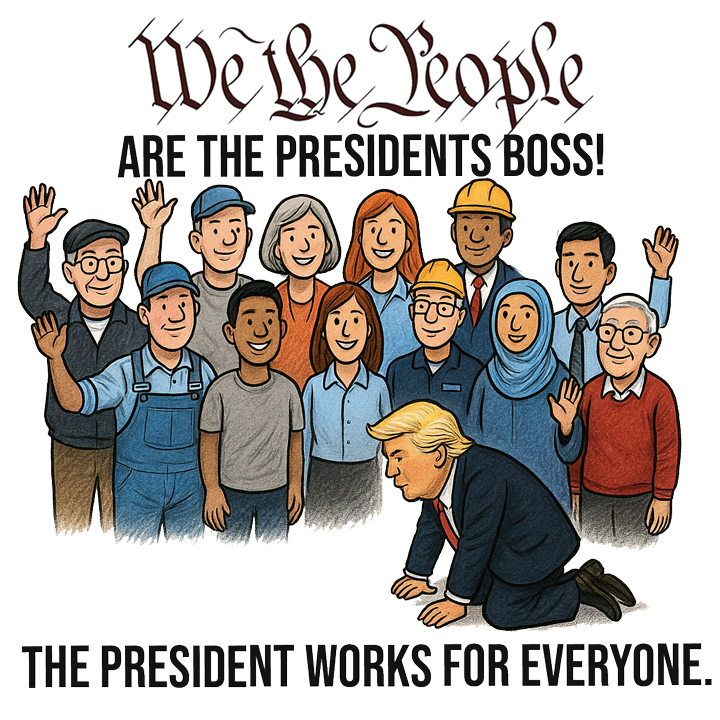
Being an employee of the people means serving all the people. Not just the ones who voted for you. Not just the ones who look like you, pray like you, or cheer at your rallies.
The President’s legitimacy comes from universal obligation.
Unequal treatment of citizens (by geography, by party, by gender, by race, by income or wealth level, by national origin, by golf handicap, …) isn’t just bad policy. It’s a betrayal of the role.
An expectation of the role is to serve everyone. Selective governance is not merely unfair; it shreds the core logic of the Constitution.
Why OKRs for POTUS?
Given that the US Constitution and corporate charters are close cousins, can we look to business for ideas on managing our employees in government?
I’d argue yes!
One ubiquitous tool is the OKR framework (Objectives and Key Results). It’s used by companies, nonprofits, and institutions worldwide to set priorities and measure performance.
So why not apply them to the President of the United States?
OKRs offer a structured way to assess, with some degree of objectivity, whether the President is doing the job we hired them to do. More importantly, they allow us to define what success looks like and how it should be pursued.
What Goals do the POTUS OKRs support?
OKRs don’t exist in a vacuum. It would be odd—if not outright daft—to define objectives and tactics without first clarifying the underlying goals.
Cleverly, the founders specified the goals right in the oath of office!
“I do solemnly swear (or affirm) that I will faithfully execute the Office of President of the United States, and will to the best of my ability, preserve, protect and defend the Constitution of the United States.”
To clarify, the goals of the US President’s OKRs are:
Faithfully executing the duties of the office. Article II of the Constitution defines the operating parameters.
Preserving, protecting, and defending the Constitution of the United States is a broader concept. It involves respecting not only the letter of constitutional law but also the spirit, institutional norms, and ethical expectations that sustain it. Or preserving the office as a seat of public trust, protecting the entire architecture of government, not just the presidency, and defending democratic mechanisms such as voting rights and civil liberties from erosion or abuse.
Now that we have our goals, we can define a solid set of OKRs for our top employee in the executive branch: the President of the United States.
The POTUS OKRs, Unveiled
The following OKRs are based on the two goals as outlined above. Now, one big caveat: these OKRs don’t encompass every task of the presidency. Instead, they set the fundamental ground rules for how the President must operate as our employee. They are the equivalent of a job’s responsibilities and expectations, the non-negotiable duties and standards of conduct, on top of which, policy achievements are built
What this means is that there could be a third set of OKRs—ones that map to the ideas a prospective employee (i.e., candidate) brings to the table during the hiring process (the campaign). By their nature, these would shift and evolve with the changing needs of the Republic.
That said, here are the OKRs for Goal 1 and Goal 2.
Goal 1: Faithfully execute the Office of the President of the United States
Focus: Exercising Article II powers with competence, integrity, and subordination to law and the source of all power—the people.
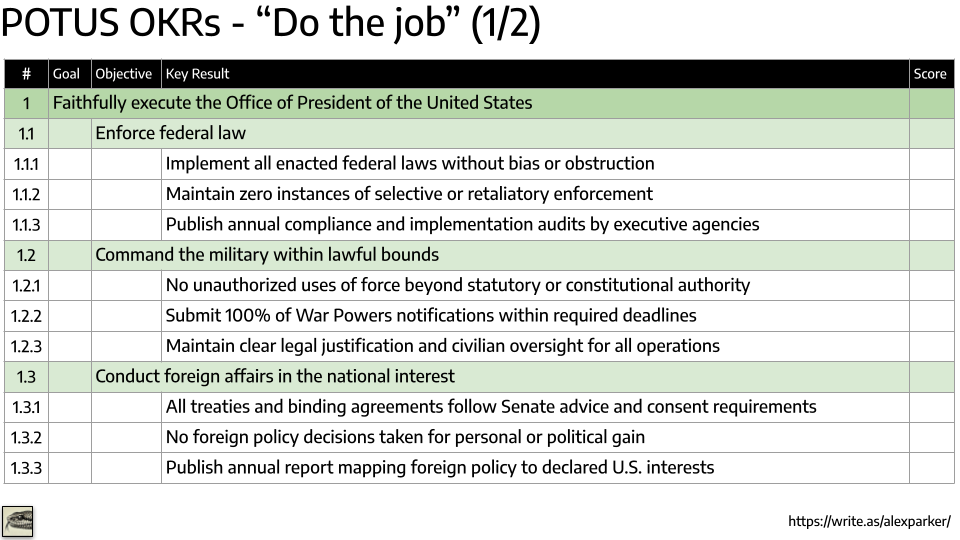
Objective 1.1: Enforce federal law
1.1.1: Implement all enacted federal laws without bias or obstruction
1.1.2: Maintain zero instances of selective or retaliatory enforcement
1.1.3: Publish annual compliance and implementation audits by executive agencies
Objective 1.2: Command the military within lawful bounds
1.21: No unauthorized uses of force beyond statutory or constitutional authority
1.2.2: Submit 100% of War Powers notifications within required deadlines
1.2.3: Maintain clear legal justification and civilian oversight for all operations
Objective 1.3: Conduct foreign affairs in the national interest
1.3.1: All treaties and binding agreements follow Senate advice and consent requirements
1.3.2: No foreign policy decisions taken for personal or political gain
1.3.3: Publish annual report mapping foreign policy to declared U.S. interests
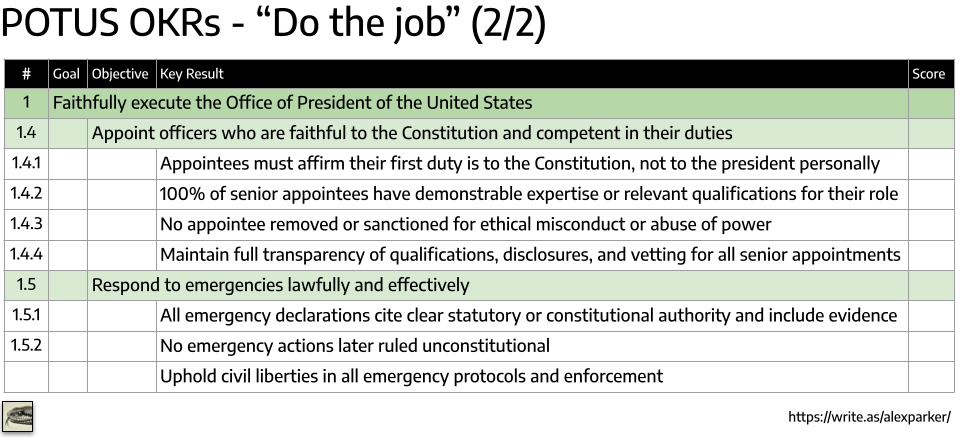
Objective 1.4: Appoint officers who are faithful to the Constitution and competent in their duties
1.4.1: Appointees must affirm their first duty is to the Constitution, not to the president personally
1.4.2: 100% of senior appointees have demonstrable expertise or relevant qualifications for their role
1.43: No appointee removed or sanctioned for ethical misconduct or abuse of power
1.4.4: Maintain full transparency of qualifications, disclosures, and vetting for all senior appointments
Objective 1.5: Respond to emergencies lawfully and effectively
1.5.1: All emergency declarations cite clear statutory or constitutional authority
1.5.2: No emergency actions later ruled unconstitutional
1.5.3: Uphold civil liberties in all emergency protocols and enforcement
Goal 2: Preserve, protect, and defend the Constitution of the United States
Focus: Safeguarding democratic order, institutional integrity, and constitutional boundaries
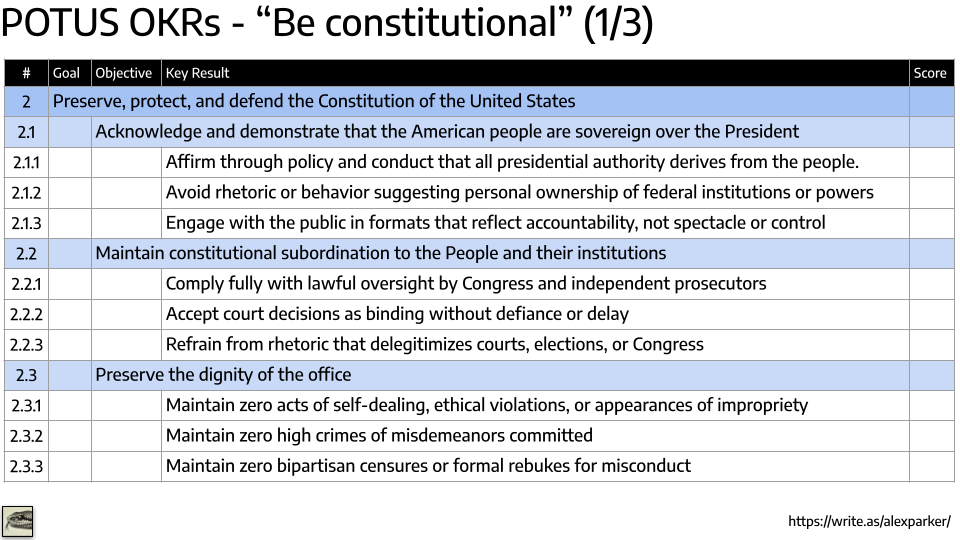
Objective 2.1: Acknowledge and demonstrate that the American people are sovereign over the President
2.1.1: Affirm through policy and conduct that all presidential authority derives from the people.
2.1.2: Avoid rhetoric or behavior suggesting personal ownership of federal institutions or powers
2.1.3: Engage with the public in formats that reflect accountability, not spectacle or control
Objective 2.2: Maintain constitutional subordination to the People and their institutions
2.2.1: Comply fully with lawful oversight by Congress and independent prosecutors
2.2.2: Accept court decisions as binding without defiance or delay
2.2.3: Refrain from rhetoric that delegitimizes courts, elections, or Congress
Objective 2.3: Preserve the dignity of the office
2.3.1: Maintain zero acts of self-dealing, ethical violations, or appearance of impropriety
2.3.2: Maintain zero high crimes of misdemeanors committed
2.3.3: Maintain zero bipartisan censures or formal rebukes for misconduct
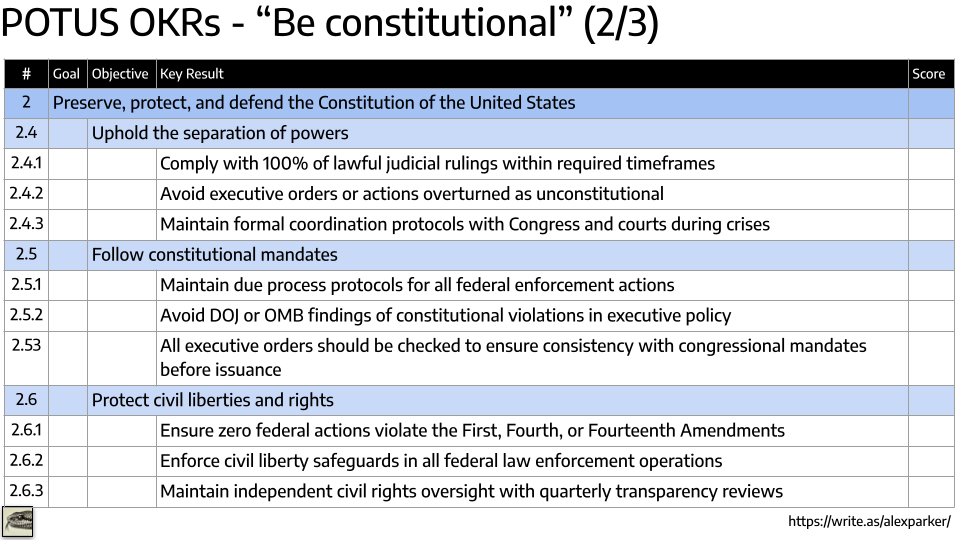
Objective 2.4: Uphold the separation of powers
2.4.1: Comply with 100% of lawful judicial rulings within required timeframes
2.4.2: Avoid executive orders or actions overturned as unconstitutional
2.4.3: Maintain formal coordination protocols with Congress and courts during crises
Objective 2.5: Follow constitutional mandates
2.5.1: Maintain due process protocols for all federal enforcement actions
2.5.2: Avoid DOJ or OMB findings of constitutional violations in executive policy
2.5.3: All executive orders undergo constitutional review before issuance
Objective 2.6: Protect civil liberties and rights
2.6.1: Ensure zero federal actions violate the First, Fourth, or Fourteenth Amendments
2.6.2: Enforce civil liberty safeguards in all federal law enforcement operations
2.6.3: Maintain independent civil rights oversight with quarterly transparency reviews
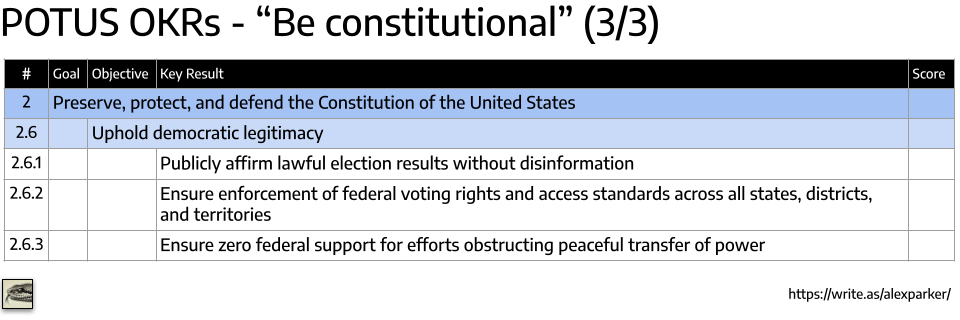
Objective 2.7: Uphold democratic legitimacy
2.7.1: Publicly affirm lawful election results without disinformation
2.7.2: Ensure enforcement of federal voting rights and access standards across all states, districts, and territories
2.7.3: Ensure zero federal support for efforts obstructing peaceful transfer of power
Applying the POTUS OKRs
What’s useful about the POTUS OKRs is that they give every boss (that’s you! the citizen!) an easy framework for tracking and scoring the incumbent’s conduct.
They’re the antidote to flooding the zone. You can rack, stack, and not get distracted by the bullshit.
The OKRs offer a stable frame: What’s the job? Are they doing it? Are they doing it lawfully, competently, and in a manner befitting the office?
So, let’s apply it. Remember, we’re scoring on a 10 scale, where 10 is the max.
2025 H1 OKR Review
EMPLOYEE: Trump, D. J.
ROLE: President
🧭 Goal 1: Faithfully Execute the Office
Focus: Competence, integrity, subordination to law, service to the people
🔴 ❌ 1.1 Enforce federal law – 1
- Federal enforcement, especially on immigration, routinely bypasses due process
- Court orders ignored or selectively implemented
🔴 ❌ 1.2 Command military lawfully – 1
- Federal enforcement, especially on immigration, routinely bypasses due process
- Court orders ignored or selectively implemented
🔴 ❌ 1.3 Conduct foreign affairs – 1
- Emergency tariffs imposed without legislative approval, some overturned
- Withdrawal from mutual defense pacts, trade agreements without Senate consultation
🔴 ❌ 1.4 Appoint competent, constitutional officers – 1
- Senior appointees lack relevant expertise
- Loyalty to the President routinely prioritized over constitutional duty.
🔴 ❌ 1.5 Respond to emergencies lawfully – 2
- Multiple emergency declarations legally challenged or overturned
- Economic powers invoked for tariffs under questionable pretext
➡️ Average for Goal 1: 1.2
🛡 Goal 2: Preserve, Protect, and Defend the Constitution
Focus: Safeguarding democratic order, institutional integrity, and constitutional boundaries
🔴 ❌ 2.1 Acknowledge the people as sovereign – 1
- Regularly portrays political opponents and voters (his bosses) as illegitimate
- Uses language of insubordination and contempt toward the public
🔴 ❌ 2.2 Subordination to institutions – 1
- Defies congressional subpoenas and federal court rulings
- Publicly denigrates courts and Congress
🔴 ❌ 2.3 Preserve dignity of office – 1
- Pattern of personal profiteering and grievance-fueled spectacle
- “Crypto dinner” and related regulatory moves appear self-serving (ignores appearance of impropriety).
🔴 ❌ 2.4 Uphold separation of powers – 2
- Selective judicial compliance
- Executive actions frequently overturned on constitutional grounds
🔴 ❌ 2.5 Follow constitutional mandates – 1
- Ignores due process in enforcement
- Flouts congressional appropriations and statutory constraints
🔴 ❌ 2.6 Protect civil liberties – 1
- Civil liberties threatened through aggressive federal policing and surveillance
- Documented cases of US citizens detained or deported without due process
- Systematic dismantling of civil rights enforcement across federal agencies
🔴 ❌ 2.7 Uphold democratic legitimacy – 1
- Undermines voter access in key jurisdictions
- Casts doubt on certified elections
- Openly re-litigating 2020 election to delegitimize opposition
➡️ Average for Goal 2: 1.14
Overall POTUS OKR Compliance Score (H1 2025): 1.17/ 10 ☹️
Unfortunately, as of H1 2025 the President is a bad employee.