Erm, Does the White House understand how to negotiate trade deals?
There aren’t many delightful things that came out of Q1 2025, but one of them was the very peculiar claim that the US administration would get ninety deals done in ninety days. It’s funny because that’s not how trade negotiations work.
How Trade Negotiations Work
Real trade deals take years. USMCA, for instance, took nearly three to go from announcement to ratification and implementation. (Of course, the agreement is now in limbo because of the administration’s behavior.)
Here’s roughly what the process looks like from tip to tail.
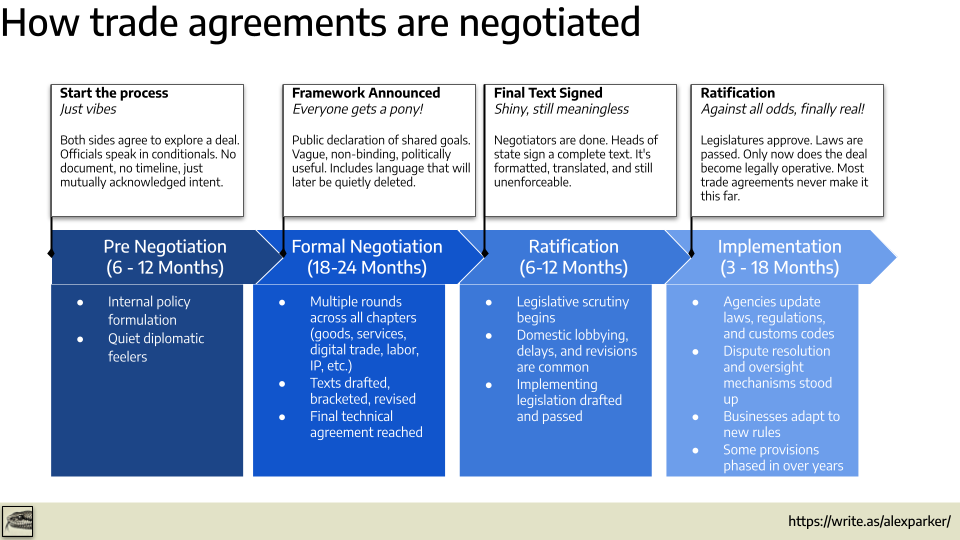
If we walk through the process, here’s what it looks like:
Milestone 1: Start the Process
Just vibes. Both sides agree to explore a deal. Officials speak in conditionals. No document, no timeline, just mutually acknowledged intent and a few polite leaks to the press.
Phase 1: Pre-Negotiation (6–12 months)
Mostly internal. Governments coordinate across ministries, consult stakeholders, and send out quiet feelers. Everyone insists nothing is happening while everyone is clearly preparing for something.
Milestone 2: Framework Announced
Everyone gets a pony! A splashy declaration of shared goals. It sounds historic but is legally meaningless. Usually includes at least three things no one will fight for once negotiations start.
Phase 2: Formal Negotiation (18–24 months)
This is the grind. Teams meet in rotating hotels to argue over digital services definitions and dairy quotas. Text is bracketed, rebracketed, and occasionally thrown out entirely. Nobody’s happy. That’s how you know it’s working.
Milestone 3: Final Text Signed
Looks real, not enforceable. Heads of state sign the final text and call it a deal. It’s formatted, translated, and ready for Congress to ignore. The photo op goes on the campaign website.
Phase 3: Ratification (6–12 months)
Legislatures now get involved. Domestic interests wake up. Lobbyists swarm. Amendments fly. In the US, implementing legislation must pass. In other countries, the entire process sometimes restarts.
Milestone 4: Ratification Complete
Finally real. After votes are counted and laws are passed, the agreement becomes binding. This is the point where trade lawyers start charging real money.
Phase 4: Implementation (3–18 months)
Agencies rewrite rules, update customs systems, and try to enforce provisions no one fully understands. Businesses scramble to comply. Some parts phase in over years, or never get enforced at all.
On July 25, where is the current administration?
For nearly all of our 190 global trading partners, including major trading partners such as China, the EU, Mexico, Canada, South Korea, and Taiwan, we’re still in pre-negotiations.
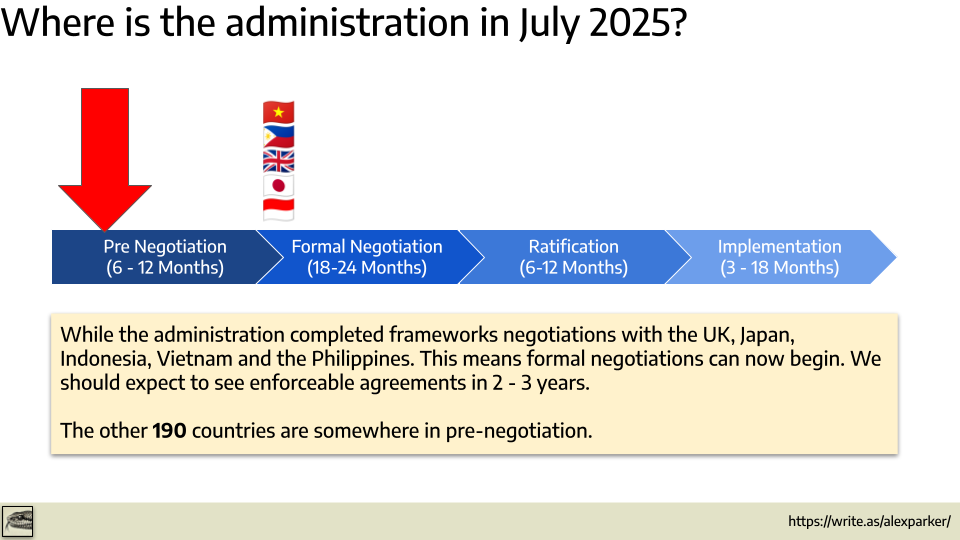
Five countries (Vietnam, the Philippines, the UK, Japan, and Indonesia) have progressed to formal negotiations. Which means all the rainbows, cupcakes, and unicorns handed out to reach the framework stage will likely shrink into a few line items buried deep in the harmonized tariff schedule. And of course we’re years away from an enforceable agreement.
The upshot?
No one is signaling anything that changes anything anytime soon.