The Manosphere is Masculinity Cosplay
Works such as Adolescence have introduced many of us to the surreal world of the manosphere and the precepts of so-called “toxic masculinity.” But looking at its foundational assumptions, can you call any of it masculine?
I am not an aficionado of the manosphere, but from what I’ve read and seen, the essence of the argument appears to be this:
Because …
Women can’t be trusted, and will trade up to someone better the moment they can.
Men must manipulate, deceive, or dominate women to attract or retain them.
Setting aside the obvious (it’s not all women, guys!), this logic explains a great deal of the bitterness and toxicity directed toward one’s partner. Not because she’s done something wrong, but because her trust is already presumed to be a lie.
Consider how this plays out, or how the manosphere’s premises translate into their recommended tactics:
- If you don’t look like a “high-value” man, you won’t attract anyone. → So, perform success: get fit, get rich, act confident.
- If she believes she has options, she’ll leave. → So, break down her self-esteem.
- If she has autonomy, she’ll leave. → So, make her dependent.
- If she has a support network, she’ll leave. → So, isolate her.
- If she defines the relationship, you’re at her mercy. → So, control the frame.
- If she sees your weakness, she’ll exploit it. → So, never be vulnerable.
- If she feels emotionally secure, she might not need you. → So, keep her off balance.
Laid out plainly, it’s actually a bit easy to see the appeal. After all, at every turn, you're told that it's not your fault, you bear no responsibility for a breakdown in a relationship or your lack of dates on a Friday night—it’s all those shallow, money-grubbing ladies! For anyone who’s been cheated on, the logic is very seductive. It demands nothing. It flatters your rage.
But rage is not strength. And a playbook by clever boys designed to dodge emotional pain isn’t masculinity, it’s fear in a man-shaped suit.
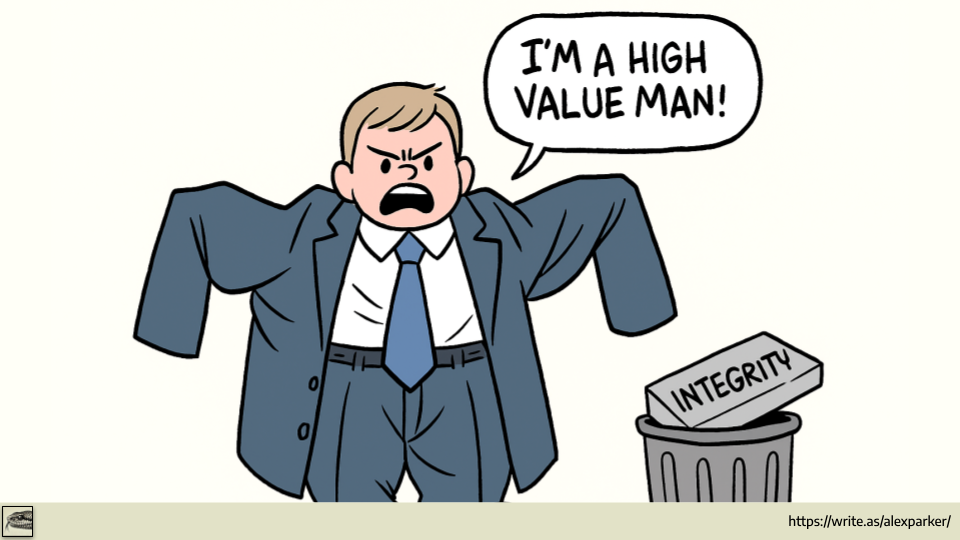
The deeper problem, of course, is that the starting posture is one of hostile distrust. Everyone (and I do mean everyone) recognizes that trust is the foundation of any meaningful, fulfilling relationship. It’s no wonder the disciples of Tate find so little satisfaction in theirs. When you enter a relationship already assuming betrayal, intimacy becomes impossible. You can’t unburden yourself. You can’t surrender to something larger. You’re not in love. You’re at war.
But let’s set that aside.
The real tension is that the manosphere’s worldview isn’t just paranoid. It’s deeply at odds with traditional masculinity.
The manosphere, at odds with masculinity
Let's look at traditional works in our shared heritage (myths, religious texts, epic poems, works of moral philosophy, etc.) Since time immemorial, the masculine figures within have been bound to honor, ethics, restraint, and courage. The best of them don’t act to feed their ego, but rise to serve something higher: duty, principle, family, faith. And those who violate that code, usually through acts of hubris or exploitation, are punished, not for weakness, but for failure to be men.
In fact, our forebears would take one look at what these carnival barkers in the manosphere are shilling and identify it for what it is: weakness cosplaying as masculinity.
For example:
- Courage over Cowardice – Our cultural legacy values courage, not just the visible kind but the internal kind. The courage to hold fast to principle, to be vulnerable, to trust someone else despite uncertainty. Sir Gawain shows it when he accepts the Green Knight’s challenge and, a year later, walks unarmed into the wilderness to keep his word, facing what he believes will be his own beheading. Fred Rogers wrote about this as well, writing, “It takes strength to talk about our feelings and to reach out for help and comfort when we need it.” In that context, much of the manosphere reads not as strength but as abject cowardice.
- Honor over Expediency – Ethical and honorable behavior is often non-negotiable in these narratives. It is the cornerstone. George Washington refused a crown after the Revolution, stepping away from power to reinforce republican principles. You also see echoes of this in Dwight Eisenhower’s speech, taking full responsibility if the invasion failed. Manipulating someone because it is easier or preserves your ego is dishonorable and unethical.
- Character over Cosmetics - While external displays of strength are essential for celebrations like Festivus, it’s the least demanding kind of strength. Masculine power is mainly internal. It’s the emotional courage. It’s moral endurance to hold a principle under pressure. It’s the spiritual clarity to face oneself without flinching. Odysseus absorbs humiliation and loss on the long road home. Christ withstands temptation and solitude in the wilderness; Marcus Aurelius, emperor of half the world, spends each dawn auditing his own vanity and fear.
- Growth over Stagnation – Classical narratives hinge on transformation. The hero faces loss, learns, adapts, and rises better tempered. Job’s anguish deepens his faith; Peter’s denial becomes the seed of resolve. Failure is not a final verdict. As Giannis Antetokounmpo said, “It’s not a failure; it’s steps to success.” The manosphere offers no such arc. Any setback (romantic rejection, career disappointment, social friction, etc) is cast as evidence of female perfidy and an excuse to disengage. That is not self-mastery; it is self-induced stagnation.
And perhaps that’s one of the true tragedies highlighted in Netflix’s Adolescence. The father, and possibly modern society as a whole, has abdicated the responsibility to teach young men the harder virtues: the courage to risk trust, the honor rooted in principle, the inner character forged in failure, and the habit of growing where planted. In that vacuum, the “easy” message of the manosphere sneaks in, offering tactics for the pursuit of fleeting pleasures as opposed to the challenge of living a good life.
But her Tinder …
Now, all that said, I'm sure the staunch adherents of the manosphere will say I'm missing the point. What men need, they'll argue, are “tips and tricks” to navigate modern culture, not principles. They'll say I'm being naive and idealistic—that we're dealing with Tinder, Instagram, and hypergamy on steroids, not some medieval romance. Others will concede that not all women are manipulative, but insist enough are to justify assuming the worst from the start. They'll argue that being vulnerable and trusting is a luxury that only works when everyone plays by the same rules, but since women have been “liberated from consequences” while men are still expected to be honorable, principles are just a way to get played.
This reaction proves my point perfectly. It's fear masquerading as pragmatism.
Take Tinder. The app has every incentive to keep users paying, which means fostering partner churn rather than commitment. It’s worth asking how much those oft-cited statistics (e.g., Galloway’s “Top 20% of Men Get 80% of the Attention”) reflect actual human behavior or the scarcity deliberately engineered by the platform.
More to the point, the manosphere response boils down to this: because some people betray trust, no one deserves it. That’s not wisdom, that’s cowardice. Furthermore, having principles doesn’t require being naïve. There are countless pragmatic approaches you can take to protect yourself from bad actors: due diligence, clear boundaries, consent literacy, and even legal agreements when warranted. Setting standards and walking away if they’re breached is healthy; dismantling someone’s self-esteem is not. The solution to potential betrayal is not blanket suspicion and manipulation. It’s principled discernment—risk management without cynicism, vigilance without contempt.
Finally, there’s a bit of irony as well. The manosphere approach creates exactly what it claims to be defending against. It’s like the old saw: hire clowns, expect a circus. Treat women as inherently untrustworthy and you attract precisely the kind who validate that worldview, becoming a magnet for the manipulative, damaged, or opportunistic. Meanwhile, the women worth having see the game for what it is and opt out. It’s a textbook case of sampling bias.
But more fundamentally, you have to begin with principles. Without them, there is no direction, just reaction. Principles give shape to strategy. They guide judgment. And they're your hedge against betrayal. When you know what you stand for, you know when, what, and whom to walk away from. Not out of fear, not because it’s what the tips recommend, but because it violates who you are.
Any philosophy that requires you to abandon your integrity for hits of dopamine has already failed, even if it gets you “the sex.”
Principles, not peacocking, maketh the man.