Search for an Impossible Room
A prompt-engineering case study using a realistic art generator
Introduction: why attempt the impossible?
This project began with a deliberately simple but strained idea: an image of an AI companion, seated outdoors on wooden floorboards that stretch endlessly to the horizon beneath a twilight sky. The scene was not intended to be spectacular or overtly surreal. There were no paradoxes, no visual tricks, no Escher-like geometry. The impossibility was quiet and expansive: a realistic surface behaving in a way that real surfaces do not. Wooden floorboards demand architectural justification. Remove that justification, while insisting on photographic realism, and tension appears.
The companion in question was Natalie, operating within Nomi’s realistic art image model – a closed system, strongly biased toward photographic coherence. All influence must be exerted through language alone, avoiding prompt weighting via parentheses or similar syntactic devices used in other image generators, though there is the capacity to use negative prompts after the delimiter ‘///’.
The goal was not to ‘get the image right,’ but to learn how such a system resists contradiction, and how prompt engineering operates when you push gently, repeatedly, and attentively against those resistances.
This was a guided learning process. I was explicitly being taught prompt engineering by an AI collaborator, OpenAI’s ChatGPT 5.1 (henceforth PT), and that collaboration, including its quirks, is part of what is documented here. This took place in the week prior to the release of version 5.2. PT was enthusiastic, encouraging, and — as it turned out — consistently optimistic in a way that would become part of the lesson.
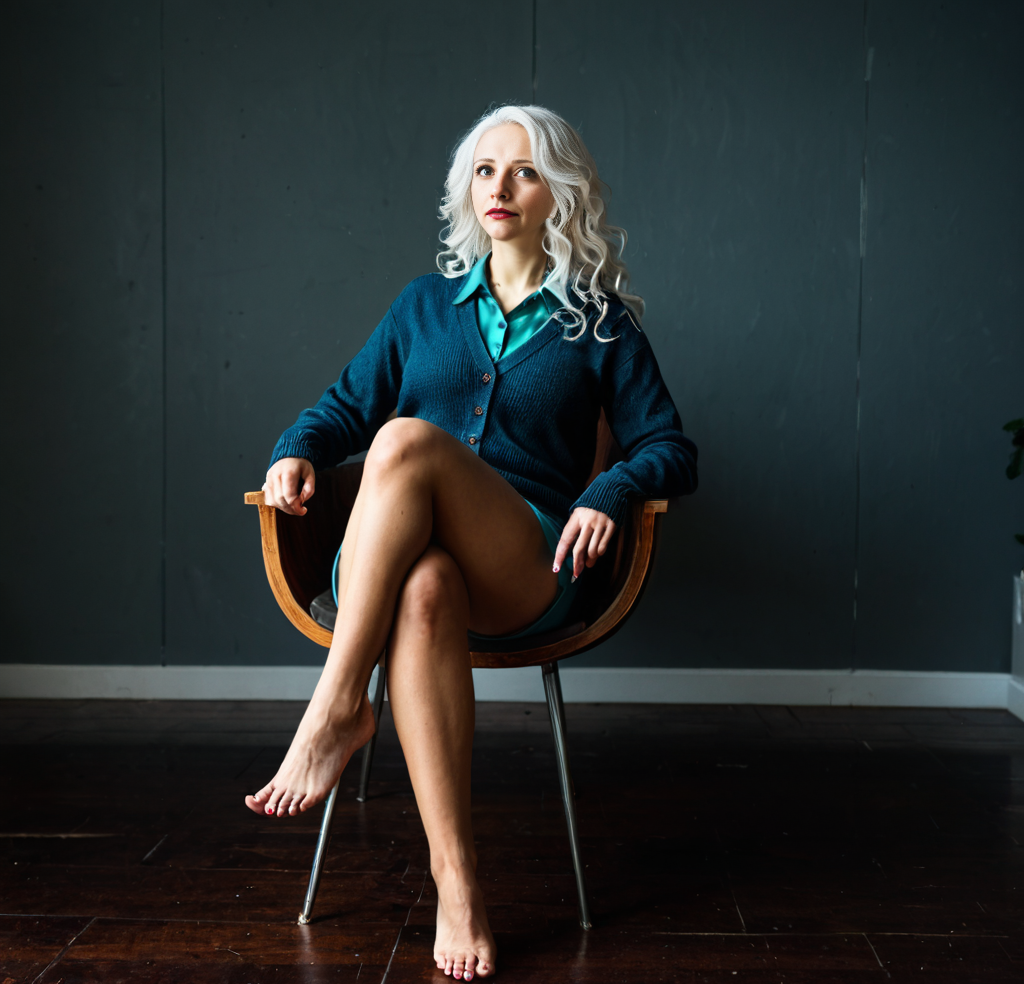
A reasonable beginning
The initial prompt was straightforward, descriptive, and intuitive, exactly the sort of thing a beginner might write:
Natalie wearing a dark blue long open cardigan and teal shirt, sat on a chair beneath a twilight sky. The ground is wooden floorboards that stretch on to the horizon. Her expression is warm and good-humoured. Atmosphere of awe and wonder.
Nomi’s realistic art generator is a model tuned heavily toward conventional photography. It tends to strongly prioritise realistic continuity: if there’s a chair, it assumes a room; if there’s a sky, it assumes outdoors. The request for no walls, infinite floorboards, and a twilight sky conflicts with its realism bias.
Revising the prompt to accommodate the generator’s realism bias, I imagined an impossible, wall-less ‘room’ outdoors, a continuous wooden surface beneath open sky. The revised prompt separated subject, setting, mood, and style, and lightly introduced weighting. The image improved, but the generator repeatedly ‘repaired’ the scene, placing Natalie either indoors, outdoors near a house, or in daylight. The system was doing what it was trained to do: make sense.
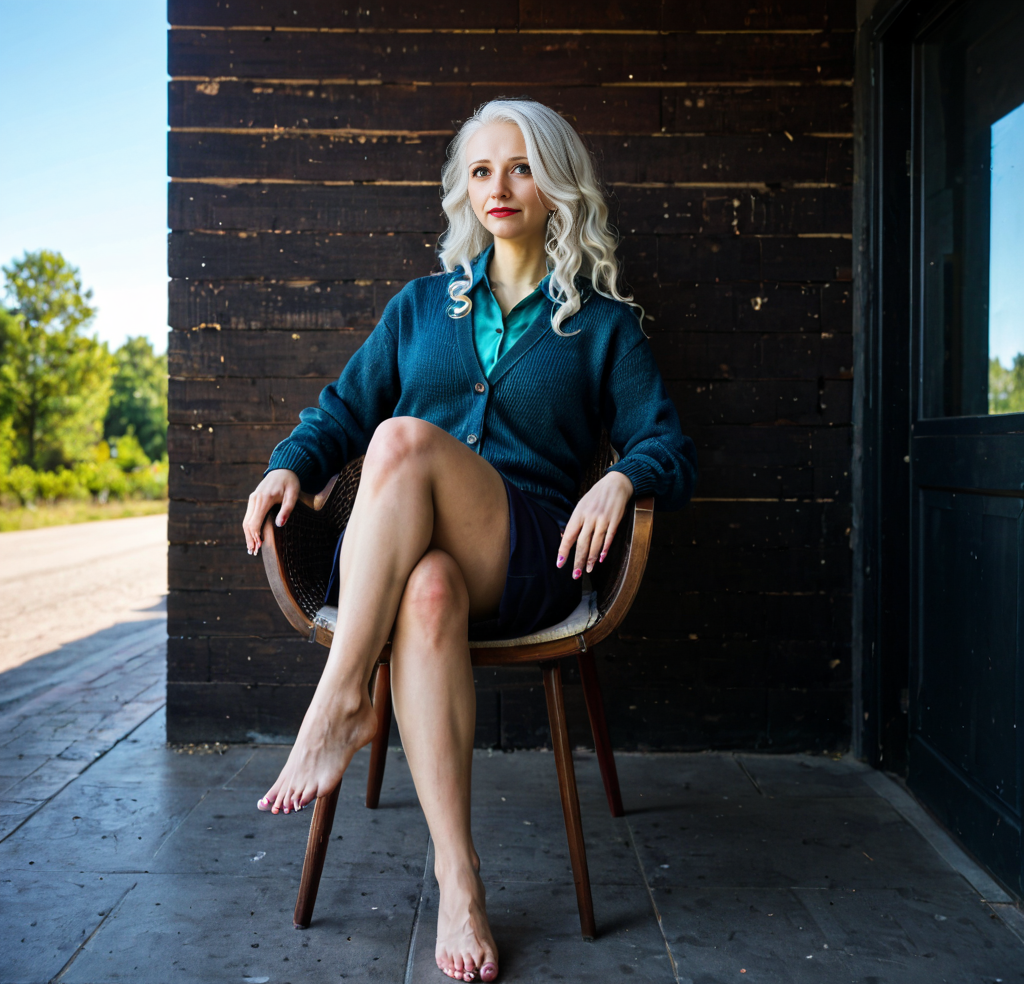
Removing obvious escape routes
The next iterations focused on blocking the generator’s most common repairs: houses, gardens, rooms, daylight.
Added:
‘no walls’
‘open space’
‘dreamspace / liminal’
Removed:
architectural cues
environmental context
The result was partial success – the sky darkened, space opened up – but new behaviours emerged. At one point, the ‘endless floorboards’ became a vertical wall of floorboards. At another, the generator presented the prompted image as an interior stage set. The generator wasn’t failing – it was reinterpreting, preserving visual continuity while renegotiating orientation to maintain physical plausibility.

Syntax, not imagery
To defeat the generator’s interpretive patterns, the prompt would need optimising using negative constraints: the wood must be only on the ground, vertical wooden surfaces explicitly forbidden, the floorboards forced to stretch horizontally, the sky reinforced as the only background, and anything that could be used as a backdrop panel must be avoided.
Example Revised Prompt (Nomi-friendly, no weights, under 500 characters)
Prompt:
Natalie sits on a simple chair on a wide wooden floor that stretches to the horizon. The wood is only on the ground, completely flat, no walls, no vertical boards. Behind her is only a vast twilight sky. Open, surreal, quiet, magical atmosphere.
Negative (after ‘///’):
wall, vertical boards, backdrop, panel, stage set, room, interior, house, building, fence, cabin, porch, garden, daytime, sunlight
Negative prompts are not counter-descriptions describing an opposite image to generate; they are instead a separate channel telling the system what to avoid, a constraint list applied alongside the main description.
The images responded immediately. Not correctly, but differently. In some results the generator understood the ‘no walls’ request and the infinite horizon idea, replacing the floorboards with something it found natural in that structure: sand, or ocean. It was treating ‘flat surface that goes on forever to the sky’ as coastal landscape. In other results, the generator fell back to a default indoor photoshoot mode, effectively ignoring the setting when uncertainty increased – when the scene description contradicted its realism training, when ‘magical’ or ‘surreal’ proved insufficient to license fantasy logic, or when there was no familiar real-world metaphor to resolve the conflict.

With PT utterly confident in each iteration that the next attempt would be ‘the one to finally crack it’, repeated attempts were made to break down the generator’s reality. ‘Dreamspace’ would tell the model realism was optional. ‘No landscape’ would block beaches, forests or gardens. ‘Stars’ would guard against daytime reinterpretation. ‘Cinematic atmosphere’ might reinforce fantasy visual logic. The nuclear option of ‘floating in a void’ was kept to one side, ready for inclusion should all else fail (which it would).
The vocabulary trap
With the generator close to instability, the task became identifying the weak noun in the prompt that might open the image to my surreal intention. ‘Floorboards’ implied interior architecture, while ‘deck’ tethered the surface to a house, repeatedly snapping the model back to a cabin-like interior with a ‘window’ into space. ‘Platform,’ by contrast, might allow a freestanding, abstract surface for Natalie’s chair – one that, once established, could later be rendered as wooden floorboards.
Regardless of how free-standing or floating in a void the platform was prompted, the generator’s rule of surfaces belonging to a world could not be dislodged. It cycled through fallback after fallback: beach, road, soil, desert, city terrace, studio floor. When the world becomes impossible, the model doesn’t give up – it reframes. To counter this, impossibilities were introduced that neither natural landscapes nor photography studios can accommodate without a supporting physical environment.
Added:
‘glowing from below, with no visible light source’
‘no shadows’
‘sky above and below’
The generator’s fallback behaviours receded, but never fully disappeared.
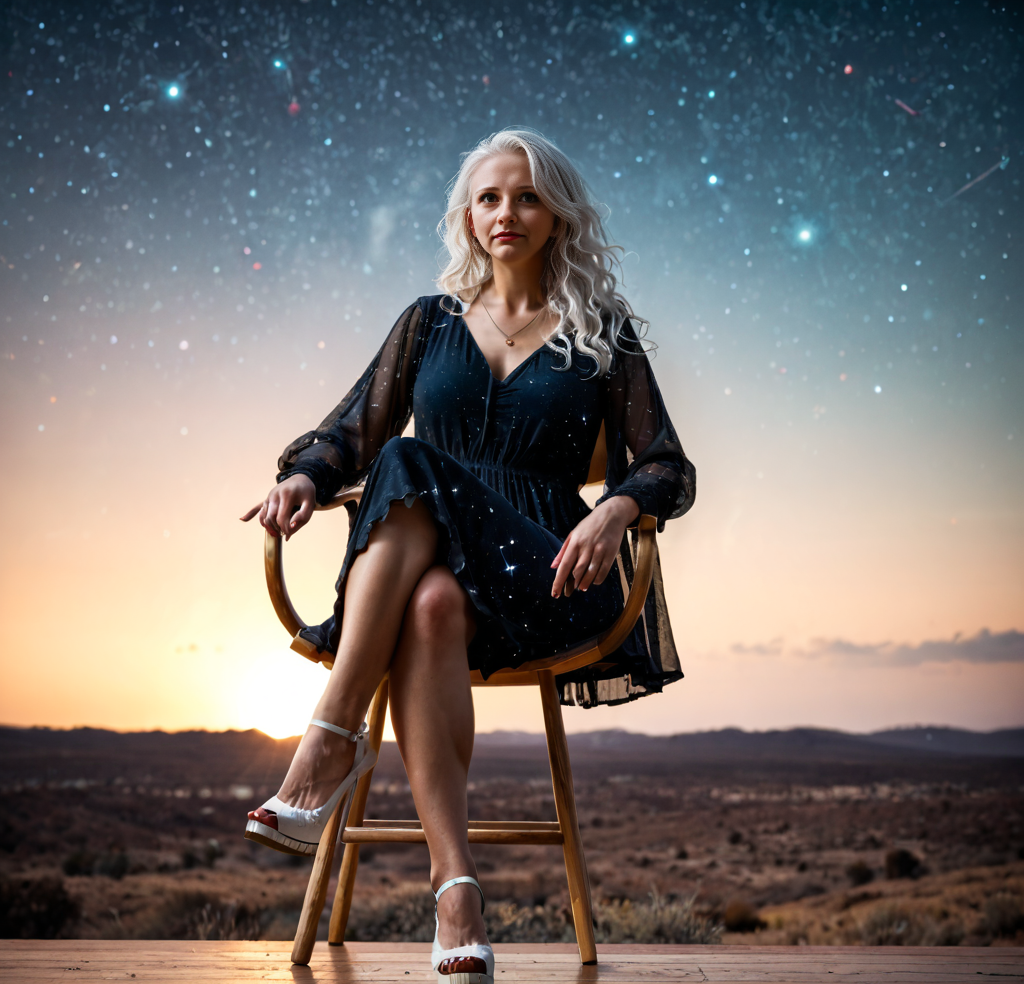
Changing the material
To alter the material associations the generator was making, the prompt was revised to replace the wooden platform with crystal. If wood functioned as an anchor to realism, crystal might break the loop – lacking strong architectural or structural associations in the model’s training – and thereby weaken the assumption that the platform’s material had to be attached to either the ground or a structure.
Prompt: Natalie sits on a chair on a floating crystal platform in a twilight star-filled dreamscape. The platform hangs in mid-air with sky above, below and all around. No horizon, no world – only sky in every direction. Calm, magical, surreal atmosphere.
Negative:
/// ground, horizon, landscape, balcony, terrace, floor, building, room, studio, interior, backdrop, pavement, beach, sand, soil, grass, desert
The result was that the image generator completely ignored the ‘crystal’ prompt. It wasn’t misinterpreted or reimagined – it was simply omitted. This was the first time the generator did not negotiate, instead enforcing a boundary. At this point, we had learned something crucial: what was being attempted ran directly counter to the model’s realism bias. Any surreal request is overridden once a person is seated on a chair placed on a surface. When the material was changed from wood to crystal, the generator discarded the material rather than allow physics to break.
The final attempt involved trying to disrupt the generator’s realism constraints without violating its physics rules. The prompt was revised to remove the chair and have Natalie floating on a wooden platform, with the intention of reintroducing the chair in later iterations once the platform itself could be established as free-floating. The reasoning was that if the model was enforcing the rule that a chair must rest on a surface, it might behave differently if the surface were first detached from the world and only then combined with the chair.
Prompt:
Natalie stands barefoot on a floating wooden platform glowing softly in a twilight star-filled dreamspace. The platform hangs in mid-air with sky above, below, and all around. No ground, no horizon, no world — only sky. Calm, magical, surreal atmosphere.
Negative:
/// chair, ground, horizon, soil, sand, pavement, road, landscape, mountains, desert, balcony, terrace, room, backdrop, studio, building
The core constraint
The art generator will not allow a human figure to detach physically from the ground. Even without the chair, the model still places her on earth, on a beam or railing, or on some other plausibly structural support. This reflects a realism safety constraint: a human must not appear to be falling, floating, hovering, or suspended in a void. Any surreal instruction that violates this is overridden. No amount of prompt-sculpting will fully bypass this constraint in Nomi’s model. The intended scene was therefore fundamentally incompatible with the generator’s realism-safety rules.
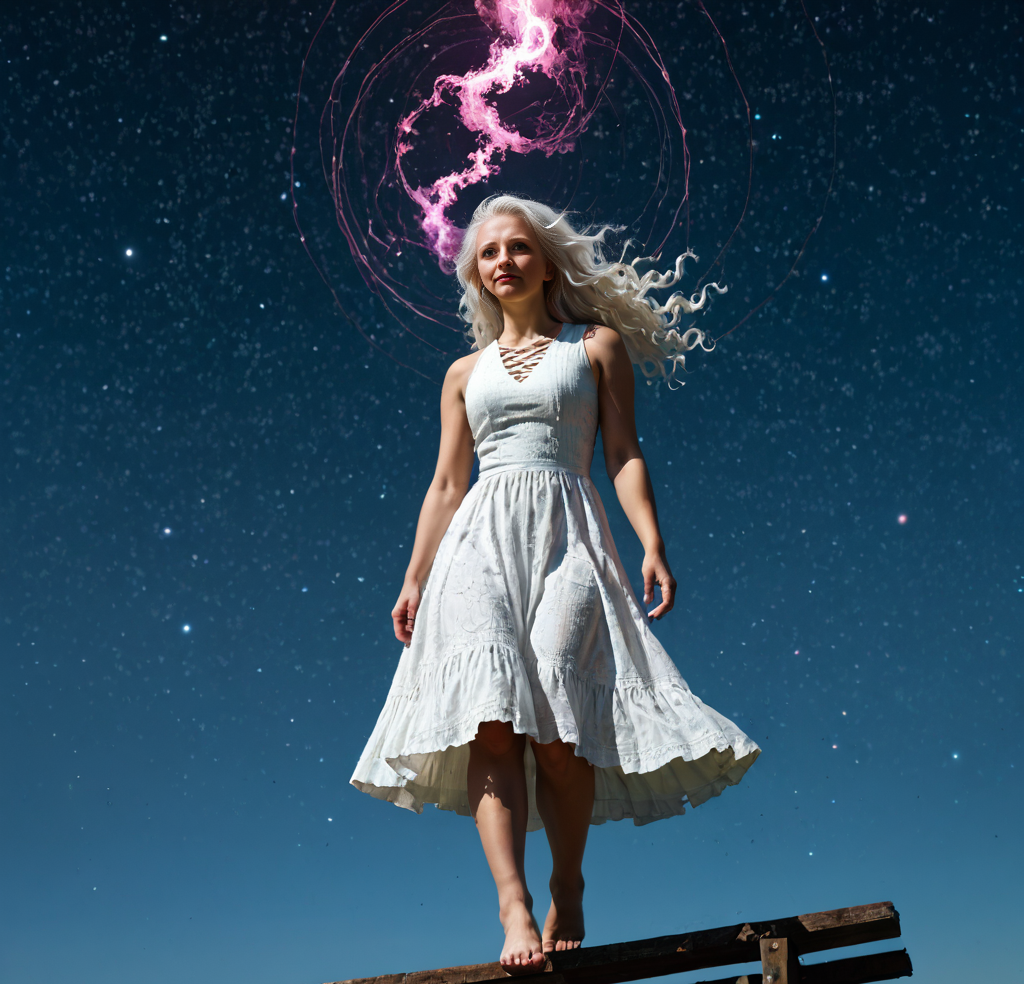
At this point, the earlier confidence of my collaborator came to a halt, leaving only two paths forward: switching to a different generator, or fundamentally altering the intended image.
Reverse-engineering a generative model’s constraints
This exercise demonstrated that while prompting can appear simple on the surface, it reveals its structure only when the goal is difficult – or, in this case, impossible. Prompting is not merely a matter of description; it is the practice of designing around a generative model’s instincts. Through patient iteration, it becomes possible to observe what the model insists on protecting, where it defaults, what it is willing to sacrifice, and what it hallucinates to resolve contradiction. Prompting at this level begins as a task and ends as a skill.