a game ends when you stop playing
noah caldwell-gervais played 2015’s mad max for 60 hours. sixty hours. he says this in his youtube video review of the game, which I watched after my own playthrough, which over less than 30 hours felt like a miserable grind to the grave by the end.
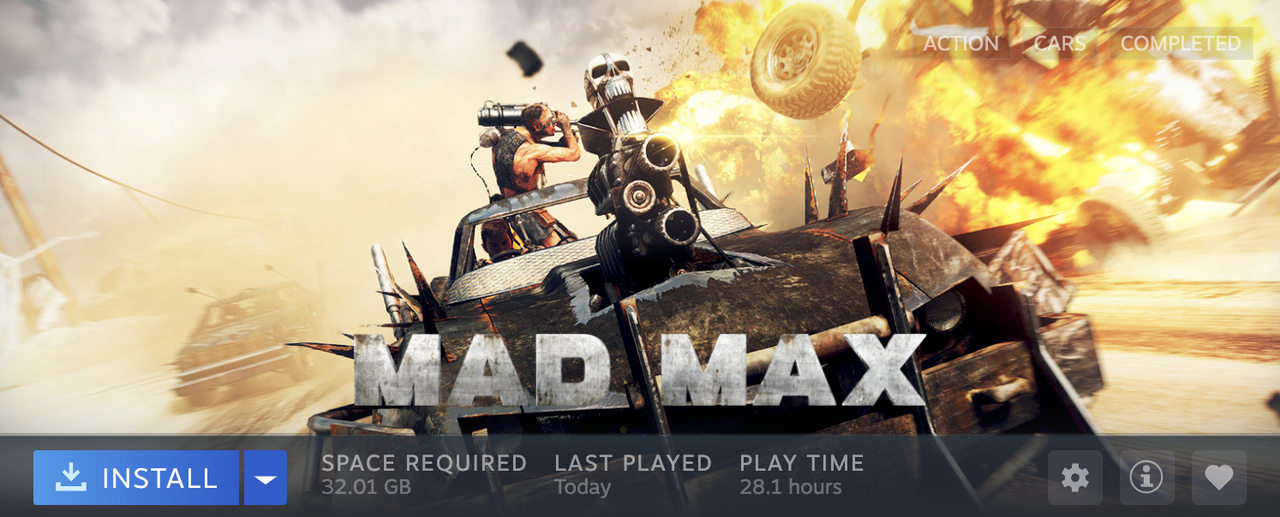
turns out caldwell-gervais’s play time is central to a big chunk of his critique of the game. he notes (correctly, I think) that the game’s economy and progression systems don’t scale well as the game goes along, forcing more and more tedious work for less and less reward. but he talks about this in terms of the game’s “latter third,” which for him were I suppose hours 40 to 60, which for me did not exist because I didn’t play nearly that long.
the place at which optional fun becomes obligatory tedium is going to differ for every player, depending on which things you find fun in the first place. to me, mad max isn’t polished or careful enough about its core mechanics to be very much fun at all most of the time. irrespective of upgrades, your car handles awkwardly (over-prone to spin outs, sluggish to turn, both too light and too heavy at the same time), often turning theoretically thrilling vehicular combat into a frustrating mess. irrespective of plot or stat progression, the combat is at best a clunky arkham ripoff, which I feel all the more because I just finished playing shadow of mordor’s superior interpretation.
this leaves scavenging and fetch quests, which are as fun and intriguing as you find the writing and narrative storytelling to be (they’re not terrible!). caldwell-gervais enjoyed the gameplay more than I did, but because he did not end the game when the story ended and instead tied “how long is this game” to the completion of a particular progression tree that I didn’t much care for, he still burnt out on the experience well ahead of his chosen ending.
basically, I think caldwell-gervais would have admired mad max more (more than me certainly, though that’s already true) if his play time was closer to mine and if he’d abandoned the car upgrade trees at the point where he was in good enough shape to, as I did, barrel through to the narrative ending and promptly uninstall. yes, the game tells you “the Wasteland is your playground!” after the credits have rolled, but who cares, really?
but… that message is the thing, isn’t it. open world games of this ilk — ones that throw checklists at you in waves — are always hard to pin down in terms of “intended” play experience, mostly by design. I often run into an issue where I save story missions for the end and wind up bogging down in stuff I care less about, only to have progressed to the point where the gameplay in the narrative sections becomes trivial. (shadow of mordor structures its story missions as tutorials almost to the very end, which did not suit this approach well at all.) but as much as I love completing a good checklist, I’m not at all compelled to 100% a game such that every achievement is met and every checklist stands finished.
caldwell-gervais took more of a “must finish the checklist” approach, partially I assume out of his love of the car progression (which, in the latter stages, is where the game’s poor scaling hits the worst) but also I think because he feels, as a professional critic, a sense of duty to play the game “completely.”
this obligation tends to carve as wide a gulf of perceived experience as anything else between critic and casual player. a critic, by virtue of station, may play a game they find boring for 60+ hours just to have the bona fides to say “yes, I played all of it,” and having had to do something boring for that long will only worsen their opinion of a game they might have just called “fine” if they dropped out after 10 hours. a casual player pouring 60+ hours into a game almost certainly does so because they were enjoying the time spent playing, and so their perception of that same time spent will fundamentally differ.
but then again I have found myself playing games for hours after I stopped particularly enjoying them (oh hey were we just talking about mad max??); games increasingly rely on loops that hook and addict brains unrelated to any sense of enjoyment or satisfaction. while they may superficially resemble media like television, movies, or books, modern games are built on loops that overrule or replace or reject our typical sense of progression and momentum within other narrative media, sticking us in place even when we don’t want to be there.
(worth saying: other media can do this to, and also you can also stop reading a book or watching a movie in the middle, and that’s fine too!)
anyway: remember that stats like those on howlongtobeat reflect averages for a reason. games are unique in that their length is a function of subjective experience just as much as any other quality. sure, there are games where the ending is very obvious and the story is very linear; there also are games where there is no ending. many games fall in between or don’t exist on this continuum at all, and the only constant across all of them is that the experience ends when you stop playing.
addendum: caldwell-gervais’s video about mad max is great, because of course it is. he’s a wonderful writer and critic. also he is more self-aware about the arbitrariness of his chosen “ending” of the game than I might be implying here.
addendum 2: if you do want to play mad max, I would beg you to install the mod “easy minefields” from nexusmods, which massively reduces the frustration and inanity of what caldwell-gervais and I agree is easily, by far, the game’s worst collect-a-thon activity.