final fantasy 13 is nowhere
I’m bad at geography. this is probably at least in part because I rely too much on google maps. (I’m actually quite good at using google maps to navigate a new-to-me city on foot; thank video games for that, I guess, because what is google maps but a diablo 2-style overlay that lets you not look at the real world while you explore it?)
when I think of neighborhoods where I’ve lived, now and in the past, what I think of mostly isn’t a map; it’s snapshots of places I’ve been, hangouts I’ve attended, bars I’ve been too drunk in. I couldn’t tell you now and never could have told you exactly how to get from one to the other; the sense of “place” exists as a cohesion of notable moments in time.
the exception to this, I suppose, is skyline-defining landmarks. those stick with me, as you’d expect. I have recurring dreams that verge on nightmares about buildings or objects overwhelming the horizon (I think maybe that shot of the alien ship breaking through the clouds in independence day scarred me).
these days I live right outside of washington DC. if I drive or take that metro train into the city, I have no sense of when I’ve crossed the Maryland-DC border but I certainly know where I am when see the washington monument.

the washington monument is my favorite thing about DC — not so much the monument itself but its omnipresence. height restrictions make it uncannily visible across so much of the city’s landscape, even though it’d be dwarfed by any average skyscraper in New York or Chicago or Los Angeles.
zoomed in, my DC is an incoherent scattering of dive bars and metro trips and museum interiors and restaurants, offices and photo ops in front of the portraits of men considered important enough to receive portraits. zoom out, and my DC is a flat, empty landscape with one big low-polygon object functioning as compass and guide.
*
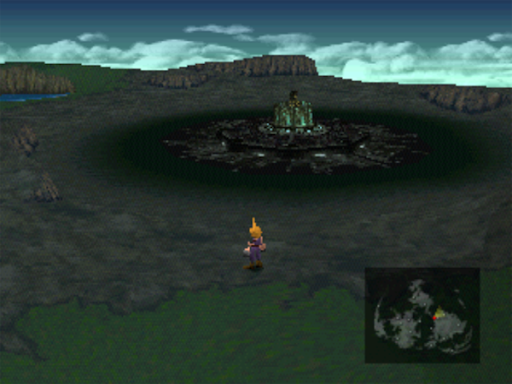
final fantasy 7 is a pretty linear video game. I don’t know how many people would agree with me on this, but it’s true. the opening hours in midgar are as railroad-straight as it gets, functioning as a tutorial ahead of the potentially overwhelming overworld, but even once you’re running around on the world map, diversions and side-quests are the exception rather than the rule for the majority of a playthrough. (unless you get really into breeding chocobos.)
I think the game’s reputation belies this somewhat, as does its proclivity for smoke and mirrors. the midgar zolom outside of the chocobo farm is a gate that feels more like a challenge; the draw distance on the world map is just far enough to give you a taste of landmarks and continents you can’t actually access yet. but there aren’t actually that many landmarks; there aren’t many places to go. you go to kalm after midgar because it’s the only place you can even reach; you go to the chocobo farm after that for the same reason. you get transportation that is barely functional enough to get you to the next story beat, and at least once will break down to essentially force you into that beat. so on and so forth until at least some time in disc 2.
this is all, to be absolutely clear, wonderful and good. as the first 3D final fantasy, 7 is shockingly masterful at conveying an alive-ness that it can’t geometrically render. its world map is deliberately hyper-real; you run around as 20-foot cloud and amble up to a single building that turns out to be an entire sleepy town, and your mind stitches together the rest with the same fabric that fills out the face of your favorite book protagonist. (this isn’t unique to FF7, of course. it’s just a great example.)
this causes the landmarks you visit to feel like proper landmarks, visible on your map not because they’re the only extant signs of humanity but because they’re notable enough to exist in this obvious abstraction you’re navigating. yet navigating them creates geographical cohesion. it’s all washington monuments. I know roughly where midgar is relative to wutai, to nibelheim, to cosmo canyon. I can see the ruin of corel in the shadow of the gold saucer. through suggestion and low-poly evocation of urban and rural silhouettes, FF7’s world feels impossibly alive for its era.
*
final fantasy 13 is a notoriously linear game. before I’d played it this year, that was my main impression of the game via discourse: its first 10 chapters are basically an overlong tutorial of un-branching corridors, and the game doesn’t truly “start” until chapter 11, when the mechanical and navigational shackles are finally removed.
what I found when finally playing it is, first of all, that the linearity of 13 is probably its strongest attribute! ff13 has a weird and weirdly told story, a lot of characters who take a lot of time to become anything like “likeable” or “coherent”, and a number of interlocking systems that are easiest to grasp by seeing them in action and having the space to play, with a gradual slope in complexity (not so much difficulty).
the game’s first nine chapters handle this beautifully from a mechanical perspective. they do feel heavy on tutorializing, but there’s also a deliberate sense of roller-coaster to the whole thing. it’s more naked than it was in 7, less willing to pretend there’s more choice when there isn’t, but both games use a roller coaster track to pace your understanding of the gameplay, the characters, and — for final fantasy 7, at least — the larger world.
(I think chapter 10 is a total failure, but for reasons that aren’t related to what I’m talking about here, so let’s set that aside.)
but by the time I hit chapter 11, I realized that final fantasy 13’s actual biggest failing is not linearity but geography. chapter 11, to reiterate, is supposed to be the triumphant “actual game,” the open part, where you explore the world of gran pulse and do missions or whatever and experience, uh, freedom I guess.
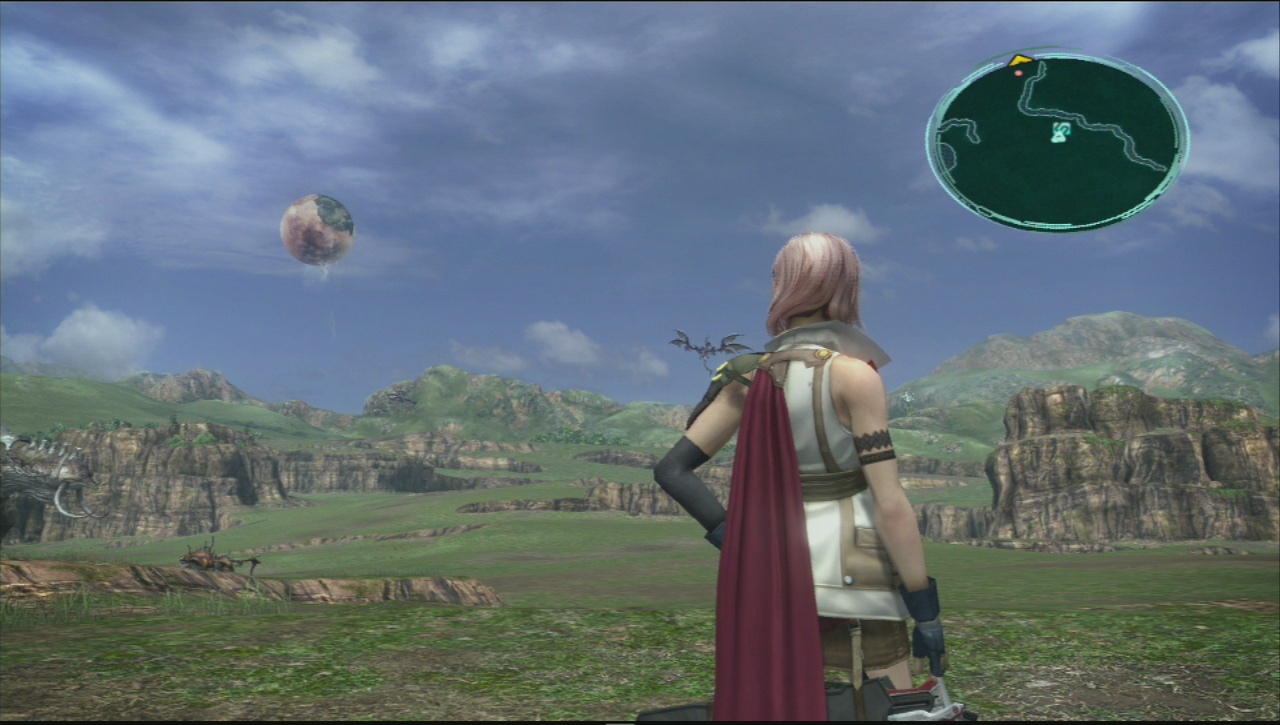
and yet: there are no towns in gran pulse, no people in gran pulse, no notable landmarks visible from a distance (aside from cocoon, I suppose), apparently no compasses because there’s no north on the map or in the UI. no monuments, no buildings, no trains, no life.
gran pulse is nowhere. its relationship to cocoon, the place/planet/thing I’m supposed to want so much to save, is uhh “cocoon is up there” — a skybox detail with no geographical connection to gran pulse because there is no overarching “world map” at all. this sort-of works metaphorically, the big ol’ wounded cocoon in the sky above the wild lands of pulse, but it is a disaster for my investment that the first-chapter description of pulse as being “the scary place down there” isn’t any more complicated even at this crucial juncture.
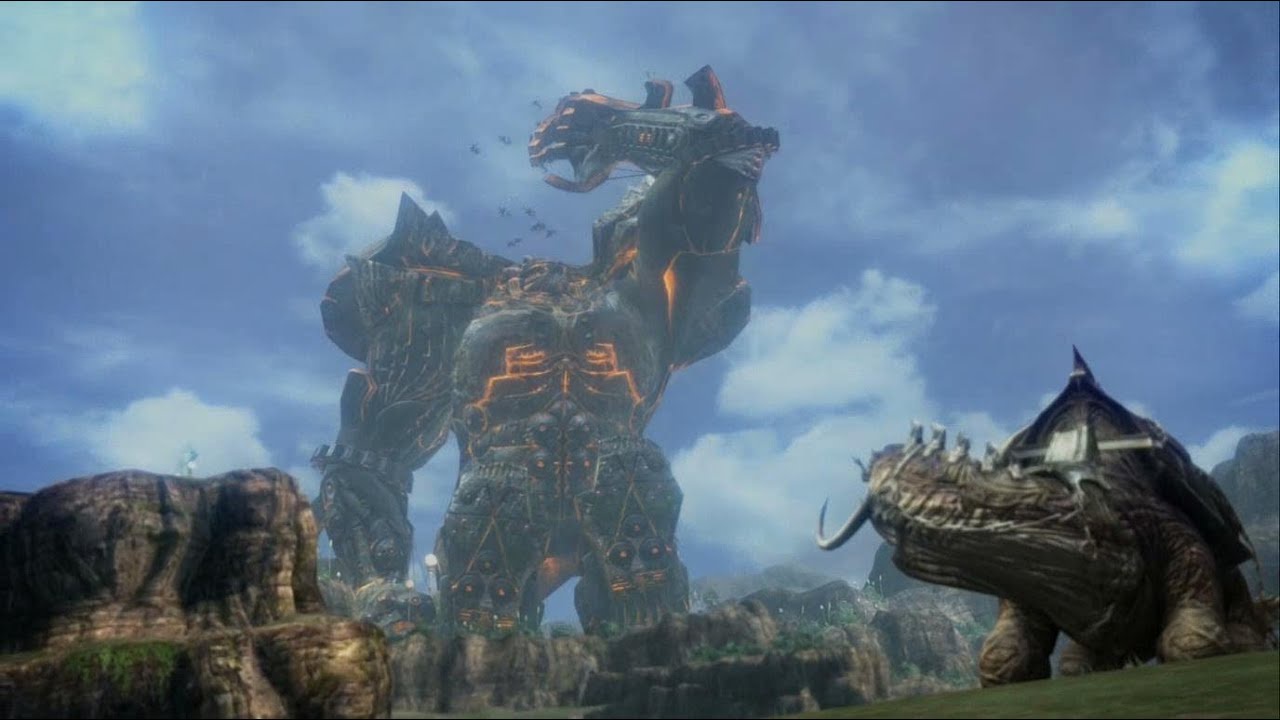
like: is gran pulse supposed to be bigger than cocoon? is cocoon a moon? I might assume yes, except it’s static in the sky, so… is it more like a floating skyscraper? is gran pulse supposed to have, or have once had, an equitable or greater human population? there’s that big collapsed bridge at one point; was this an urban center once? was the urban center over there? is gran pulse a whole planet or a single landmass, continent, country, region in a wider world?
the game gives no points of reference to even guess at the answers to these questions, much less creating any visually striking way to imagine them. I don’t need specific answers to these questions, but I’m unsatisfied with the amount of sketching the game provides; the dots are insufficient for my brain to draw all the lines in. gran pulse has a lot of monsters in it and absolutely no life.
in the end, it’s not the first ten chapters but the whole game that feels like a corridor, puny and miniature in scope for all its PS3-next-gen visual splendor. no monuments; no buildings; only the roads between. you might as well be running in a hamster ball with enemies occasionally hopping inside. (this is, incidentally, more or less exactly what the final chapter feels like.) maybe this was a problem of project scope creep; 13 certainly does feel like a game suffering from rush-job syndrome in a lot of ways aside from this.
my comparison with 7 is not meant to suggest that 13’s doing this “wrong” but to point out that you don’t need to draw in every detail of the map to make that map feel alive, to make a pre-rendered background feel like a place, to make me care about some pixels. so much of the artistry of video games is in their abstractions and suggestions, their skyboxes and mechanical representations and musical cues. 13 has many lovely examples of these, but almost none of them exist to create a sense of location, and so most of the game happens nowhere, in chaotic blank skies and inexplicable race tracks and I never see one place from the next. none of it coheres. final fantasy 13 is nowhere.
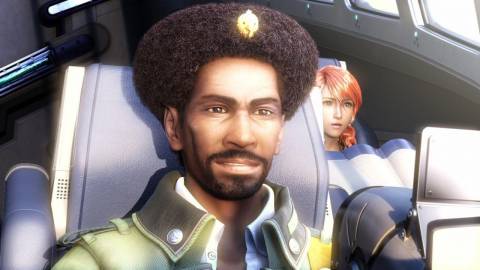
I don’t hate final fantasy 13 at all, to be clear. I’m fond of most of its mechanical systems, which looked at broadly signal a willingness to cut away a lot of chaff in the interest of finding loops and satisfactions core to “a final fantasy game.” this game’s combat system, beautiful and fast and flashy and well-structured, is what final fantasy 7 remake’s should have been. the aesthetics are great even when they’re not especially coherent. turning summons into gonzo BDSM transformers? hell yes.
but for as much as I want to praise 13’s willingness to cut away, it’s probably too much to cut away the mechanical and geographical structures of the world while telling a story that needs me to care much about planetary lore.
quick post-script: please do not tell me about the degree to which any or all geographical questions are answered in 13’s sequels. any such work would not retroactively make 13 any more of a failure on its own merits.