Review: Moving Across the Landscape in Search of an Idea (anthology)
Multiple authors (anthology)
129 pages
air & nothingness press (2024)
Read this if you like: formal experimentation, flash fiction
tl;dr summary: Collection of 18 flash stories across genres that make use of footnotes and other marginalia to tell narratives in a new way.
See the book on the air and nothingness press website
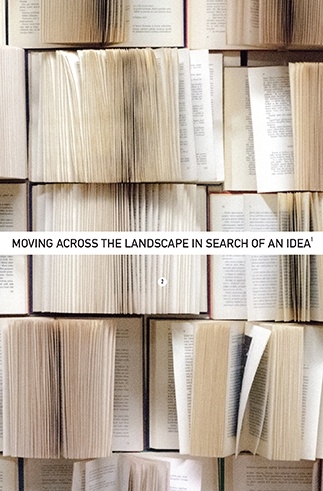
The call for Moving Across the Landscape in Search of an Idea set the following requirements for writers:
- A long title
- Copious footnotes (at least 250 words)
- A total length of no more than 1,500 words.
…the end result is one of the most unique and entertaining short story anthologies I've read in recent memory. Now, I'm a sucker for a weird form. If a story uses footnotes, or claims to be a found manuscript, or is told in the format of an annotated technical manual—I'm already 90% to loving it before I read a word. Basically, I'm the exact target audience for this anthology, and it's no surprise that I found it absolutely delightful from cover to cover.
The main thing I love about devices like footnotes is that they give readers multiple ways to enter the story. I found myself lingering over the stories longer than I typically would with an anthology, reading once with the footnotes and once without them, or cycling back to the title after I'd read the whole work. All the different ways to experience each story make them so fun to read.
Despite my bias, though, I do think this would also be a great “gateway collection” for the formal-experimentation-curious. In part because the stories are so short—if you're not digging on one story, you can just move on to the next. And they all take their own unique approach to the use of footnotes and other marginalia, along with spanning a whole gamut of genres and styles, so the odds are high that at least one of them will catch your attention.
In a whole collection sense, one strength these stories all share is that their experiment with form feels fully necessary for the story the way it's being told. It isn't just a gimmick. The footnotes introduce a new voice, or the comments add context necessary to get the right meaning from the main narrative. They're all impeccably crafted when it comes to their internal story logic, and the “why” behind the story's form is woven into that logic.
I also think this collection has a lesson to teach writers about titles. The titles of these stories do a lot of work to set the context for the reader, putting them in a time and place, or giving key details about the character. Granted, you're usually not going to want to use a title that takes up a whole page—but the ways these pieces use the titles can be shrunk down to a smaller scale. By front-loading information in the title, the stories jump right in without needing to explain how the world works, or where the character is, or some other important thing that would otherwise probably need a good amount of exposition.
While there are too many stories in this collection to go into full depth on all of them, I did want to highlight some of my favorites:
- “In Which Grace Agatha Zimmerman...” – A delightful story about a little girl with a monster under her bed that balances a light tone with ominous undercurrents in a highly entertaining way.
- “Before I Died...” – Ghost story from the POV of the ghost, layered over a Carver-style family story. The way the footnotes were used here to differentiate voices was one that stood out to me, an intriguing way to employ the device especially when paired with the title.
- “The Cool Side of the Pillow...” – This one might make the best use of the title out of all of them, constructing the protagonist's entire life and mental place before we open on him floating in space, the first test subject of a time travel experiment, with no clue if he’s going to get rescued or die there. The story itself is a beautifully bleak contemplation of regret.
- “Catalogue #1334 of the Time Travel Museum Collection...” – Speaking of beautifully bleak, this one tells the story of a man who's so desperate to fix his relationship with his daughter he breaks the rules of his time travel device. Craft-wise, this one made beautiful use of form for worldbuilding. The core “narrative” is the manual for the time travel device, with annotations from the doomed user. This lets it literally spell out the rules of the device and use that as a point of narrative tension. A similar thing is done in one of my other favorites...
- “The Custodian's Manual for Working Aboard the Generation Ship Unageing Intellect...” – This one takes the annotation idea a step further with nested annotations from various generations of custodians. These are what tell the narrative, which unfolds around a central idea rather than flowing in the way we'd typically think of narrative time.
- “Would anyone care to explain...” – A bad review annotated by the employees trying to explain what really happened, all set in a magic restaurant that has a cauldron with life-restoring powers. Very fun play with voice and excellent use of the form to delay the reveal of information until just the right moment.
- “This Is The Title The Artist…” – Written as the exhibit label for a work of art with a ridiculously long title displayed in a museum, this one doesn’t have a narrative in a traditional sense but it sure takes readers on a journey.
My expectations for air & nothingness books are high. The things I've read from them in the past set quite a lofty standard, from both a writing quality and a design standpoint. Even given that, this anthology blew me away. I kept finding myself stopping to read the stories again while I was going through the book to write this review because some of them are like flash fiction Pringles that I just can't stop reading once I start. For craft study, I'd definitely recommend this one to any writers who like to play with form, even if you typically don't take it as far as some of these authors do. And strictly from an enjoyment standpoint, I'd recommend it to anyone who likes reading new ways to tell stories.
See similar posts: