Review: Halfway to Better
Susan Kaye Quinn
125 pages
Self-published (2024)
Read this if you like: Solarpunk/climate fiction, Becky Chambers, Kim Stanley Robinson
tl;dr summary: Six stories set in near futures where we haven’t fixed shit yet, but we’re getting there.
Solarpunk and hopepunk are among those newer subgenres that I'm intrigued by but haven't read enough of yet to really get a sense for what they're all about—and was, admittedly, a bit confused by the description. I'm used to the -punk suffix being affiliated with subgenres like cyberpunk, associate it with a certain kind of darkness and dystopian sensibility that feels slightly at odds with what I understand solarpunk to be.
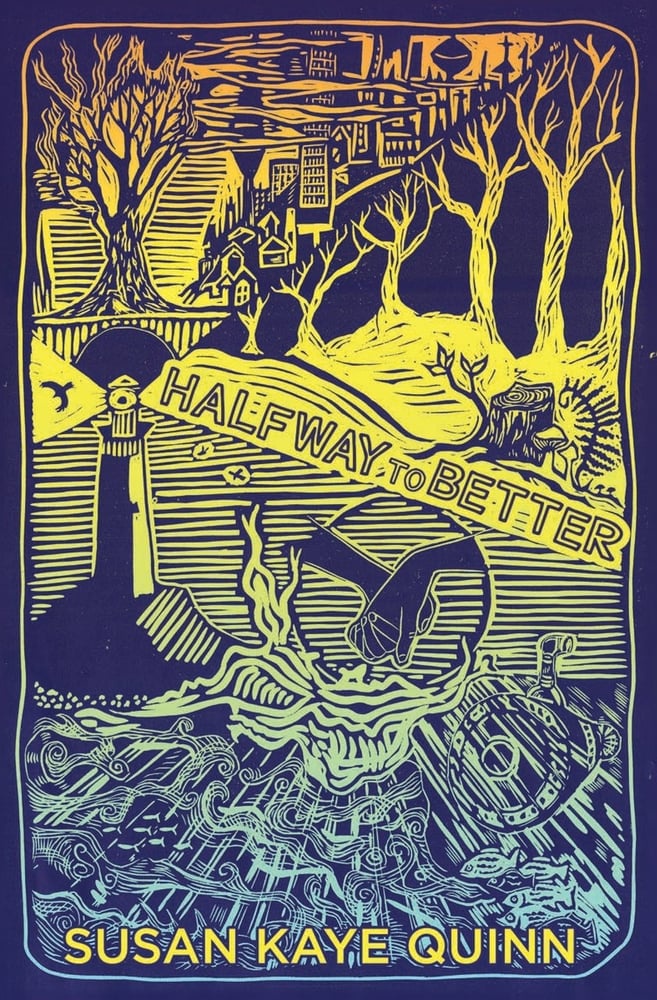
Halfway to Better is the first single-author solarpunk collection I've read and I found it to be a very effective and enjoyable introduction into this genre landscape. I like that the included stories show a lot of variety in terms of their voice, plot, and settings, but still all share a common through-line of humans dealing with the ramifications of climate change. I also appreciated the overall tone of this collection, which had what I felt was just the right level of optimism. All of the stories envision a better future, without ignoring the realities of the darker present where they take place.
This is a relatively short collection, containing just six stories. It kicks off in the near-future deep oceans of Earth with “Slimy Things Did Crawl”, which felt like a smart placement choice. The story balances interpersonal conflict against the broader environmental tension well, and it resolved both in a very smart way. It also gets bonus points for monster fun—if I had one critique, it's that I think it could've gotten to that portion a bit faster, although I also did enjoy the interplay between the characters in the first part of the story.
The set-up of the second story, “Tower Girls”, echoes back to those other more familiar -punk subgenres. I have a soft spot for stories that create in-world urban legends, so I particularly enjoyed the myth of the “13th floor girls”, and the play on what it means to be an “illegal person” was another intriguing detail. The love story through-line was a bit on the sappy side for my tastes, but only to the eye-roll level, not enough to keep me from enjoying the story.
The third story, “Planting the Shell-Bones”, was one of my personal favorites in the collection. From a craft standpoint, I was impressed by the way the setting and narrator were constructed in tandem, and how they engaged with each other in a very real-feeling way. The optimism in this one also felt very much earned, and like in the first story the character's arc and motivation are nicely woven in with the environment. The themes are there but don't feel heavy handed because they’re organic to the world and the character, which is a lesson I think many climate fiction writers can learn from.
On the other side of things, I would say “Tombs Without Bodies”, the fourth story, was probably my least favorite in the collection, only because it was missing some of the distinctiveness I enjoyed about the other stories. The idea of a world where the rich live in towers and the poor are scavengers—that's something I've seen done before, and the plot movement and villain also felt a bit more derivative to me than the ones employed in the other stories. That said, I still enjoyed reading it, and I liked that it leaned into more of a theme of “power through community” than I was expecting from the setup.
I also think that perhaps “Tombs Without Bodies” suffered from bad placement luck because it's sandwiched between my two favorites. “The Day We Stopped Burning” has the most lyrical voice in the collection, and it's used to very good effect. The use of the “you” voice is smooth and makes sense with the narrative. This one is also an excellent example of a setting that's both vague and specific—the reader doesn't get many concrete details about the world, but we don't need them. The hints we're given through the voice and the way the characters engage with their environment are effective at pulling the reader into the world and making them care about the characters in not very much space.
While the final story (“I Came Home From Saving the Rainforest”) wasn't necessarily my favorite, I did find it a lovely way to end the collection. It felt the closest to the present in terms of time setting, and reinforced that idea of strength through community that echoed in other stories. I also like the kind of hope it features as a parting message—not just hope in a better future for the earth, but hope that people can change for the better, too.
In a general sense, I'm always a bit wary of fiction with a message, like climate fiction, because I've read a lot of it that comes across as preachy or heavy-handed. From the first story, I could see that Halfway to Better side-stepped this pitfall by focusing in on the characters, centering the personal impact of environmental destruction and the individual actions taken to correct it. While I had my minor quibbles with a few stories, they all succeeded in balancing a bigger message with an entertaining story, and that alone makes it worth reading, in my estimation.
See similar posts: