Review: Out of Atzlan
V. Castro
186 pages
Creature Publishing (2022)
Read this if you like: Feminist horror, optimistic post-apocalypses, Aztec mythology and culture
tl;dr summary: Collection of short stories featuring powerful women fucking shit up in various ways and places.
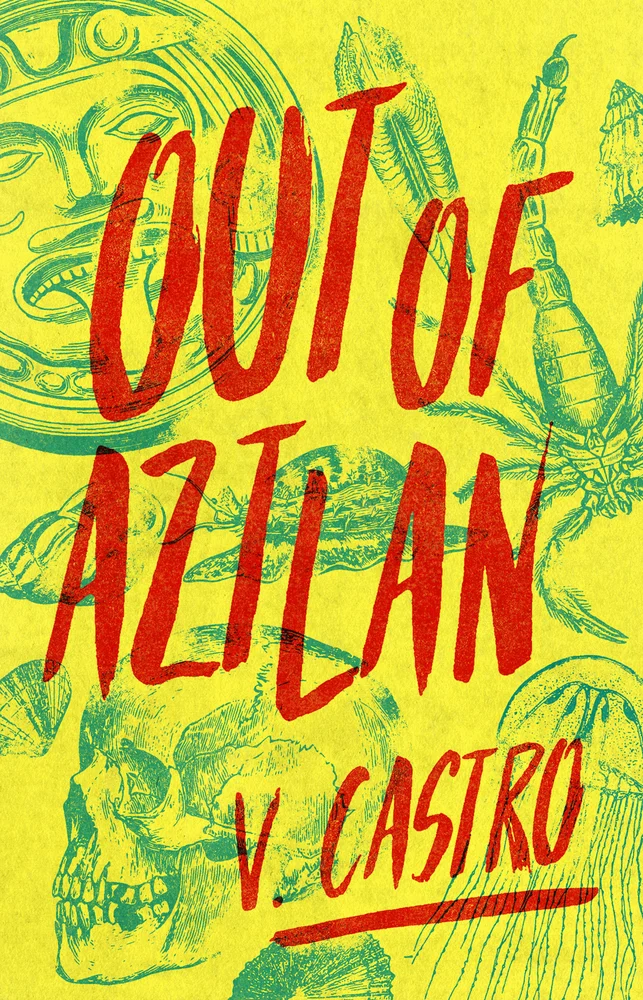
My first experience reading V. Castro was her novel, Goddess of Filth, which I found an enchanting blend of Aztec mythology with an updated take on the coming of age narrative. Based on how much I loved that work, I knew I had to get my hands on her story collection when I saw it beckoning from Creature Publishing’s table at AWP. Reading its back cover summary only made me more excited. There was obviously a speculative element in Goddess of Filth—it centers on the idea of a teenager being possessed by an Aztec goddess—but the setting was real-world present, the characters by and large human. I was excited to see how Castro’s voice would translate to the more far-flung forms of speculative narrative that were promised in this set of stories.
Out of Aztlan is what I’d call a semi-linked collection. All 8 stories are bound together by the unifying theme described on the opening page. “I wandered for years in and out of different skins, colors of lipsticks, shoes, and beds. But still I could not find the path that led to Aztlan,” this passage starts, going on to conclude that she is Aztlan, “And we all have our own Aztlan. We just need to allow ourselves to be led back.”
Each of the characters featured in this collection are doing this in some way: allowing themselves to be led back to their true path, or their true selves—or, in many cases, exerting their will to reframe their present circumstances and align them with their true purpose. Another unifying thread across the collection is that all of them feature a female protagonist, predominantly in a first-person voice, though with a few instances of third-person scattered throughout. In some cases, she has a male love interest who also has his own arc, but even when this is the case the woman’s perspective is clearly the focal point, and there are several stories with almost entirely female casts—something that I found to be refreshing, not just for the fact that this is rare to find in a speculative fiction collection, but also because it felt completely natural, so much so I didn’t consciously notice until I was thinking back through the stories in preparation to write the review.
Despite these similarities in regards to theme, character, and POV, the stories in Out of Aztlan don’t ever feel repetitive. Castro accomplishes this by offsetting the similarities with variety in regards to setting and plot. Interestingly, the stories that are closest to existing in reality are the first and the last, book-ending the more fantastical works in between. The first story, “Templo Mayor”, is set in a speculative near-future that is an exaggeration of the post-Covid world. In this reality, the quarantine lasted longer, for five years, and was accompanied by blackouts and other catastrophes that left people feeling even more isolation. The unnamed protagonist travels to Mexico City as the last stop on an adventure of rediscovery, ending up alone with a supposed guide who promises to lead her into a previously unexplored chamber of the Templo Mayor. He turns out to have more sinister motives, leading into a satisfying “hunter becomes the hunted” kind of narrative that ends with the discovery of a living goddess, Coyolxauhqui.
The theme of a woman reclaiming her power through violence is central to the anchor story, “Palm Beach Poison”, as well. In this one, though, the protagonist is a maternal figure, turning to violence not in defense of her own life but in vengeance for wrongs done on her daughter and other exploited young women. This is the only story that feels like it could take place in reality, with no speculative elements, and weirdly was also one of my favorites, I think because of how well the powerful protective urge of protagonist Ms. Dominguez comes through on the page. She feels like a real mother with understandable motivations, and an easy character to root for.
In between these near-reality settings are varying degrees of slant reality. “Dawn of the Box Jelly” is set in a very near future, where the warming waters and ocean pollution have had an unexpected impact on sea life. “Diving for Pearls” gives the reader an alternate history of the indigenous people made to risk their lives to gather pearls for the Spanish conquistadors. “Asylum” is a slightly further post-apocalyptic future that flips a cartel leader from villain to hero. “At the Bottom of my Lake of Blood” seems to be set in a more different near-future apocalypse, though told from the POV of an Aztec death goddess resurreced in the process. “Lobster Trap” has a fun POV, too—a lobster plotting revenge on humans for hunting her kin.
The story that’s the most speculative in terms of setting is “El Alacrán”, which is another post-apocalypse kind of narrative, though set far enough in the future it feels like a secondary world. This is also the longest work, which I appreciated—it was a world I was happy to linger in, with a fun magic swasbucklers kind of vibe. The protagonist is the titular Alacrán, or scorpion, captain of a pirate ship in a post-technological world, who has to team up with her arch rival Ossibus to resist conquest by an invading king. “El Alacrán” might just be my favorite piece in the collection and I especially appreciated its structure—the details of the characters and world are used very effectively to help build tension and add stakes, and it’s got a page-turning pacing that I appreciate in a story of this length.
My only major critique of Out of Atzlan is less one of writing than editing. There were aspects of it that made it feel a bit rushed—enough small typos and other proofreading errors for me to notice, for one thing, but there were also places the writing itself felt like it could be tightened. That said, it was never enough to pull me out of the story, and when it comes to core elements like worldbuilding and character development, it’s well-crafted. The stories in this collection blend genres in a very fun and fresh way, and they’re full of characters who are easy to root for.
See similar posts:
#BookReviews #ShortStory #Horror #Speculative