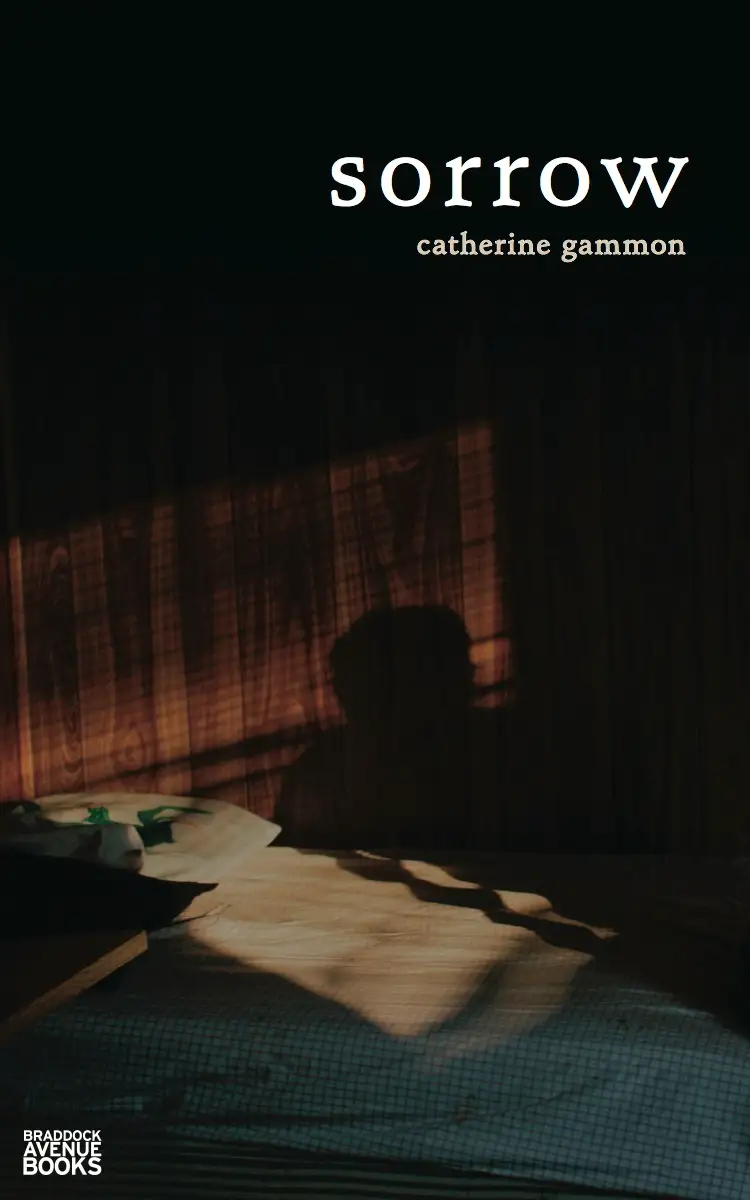
Review: Sorrow
Catherine Gammon
Braddock Avenue Books (2013)
296 pages
Read this if you like: voice-driven fiction, Carmen Maria Machado, Virginia Woolf
Tl;dr summary: A woman dies under mysterious circumstances in a New York apartment building—and then shit gets weird.
See the book on Braddock Avenue Books
I love stories that subvert the reader's expectations early on. What's particularly impressive about Sorrow is that I didn't really have many preconceptions about what story it would tell before I started reading it—and it still completely threw me for a loop within the first 50 pages. The only problem with this is that it makes the book unfortunately tricky to review, because it's very difficult to discuss some of the most compelling aspects of the story without revealing details that will spoil that effect for other readers.
What I can talk about without as much risk of spoilers is also the aspect of this book that I find to be the most compelling: the voice. Gammon wields a floating 3rd person artfully throughout the novel. At times it takes an omniscient distance, with a perspective that hovers outside the characters and dips into different individual perspectives as needed. Other times it dives more deeply into a single point-of-view, usually Anita's. When this happens, the prose takes on a much more stream-of-consciousness style and an elevated level of lyricism that gives it a dreamy feel, mirroring Anita's disconnection from reality. In some contexts I might find this switching to be jarring or inconsistent, but the way it's wielded here is very effective in driving tension and shrinking the distance between Anita and the reader.
Anita's perspective ramps up into this full stream-of-consciousness kind of voice, but the omniscient shifting is used from nearly the beginning. The way it's used in the second chapter struck me as particularly effective. The perspective pans across the apartment building where many of the characters live, showing a snippet of how each person is spending their evening. The reader doesn't yet know exactly which characters are important at this point or how their various narratives will intersect. As a result, I found myself paying equally close attention to everyone's story, attentive to details that might seem tangential or unnecessary if they were presented in a different way.
From a craft standpoint, what I found most intriguing about Sorrow is how it skirts the edge of speculative, and how much the voice plays into this feel. There are some brief moments where a ghost is a perspective character, but aside from these the book is firmly in the real world. Despite this, it has the feel of urban fairy tale or magical realism, and those shifts into lyrical stream-of-consciousness are a large part of this. They untether the reader from reality in much the same way as introducing speculative details would. This is reinforced by the plot movement, which follows a kind of fairy tale pacing and cause-and-effect logic. Read as straight realism, there are some plot developments that would seem a bit too coincidental, the timing slightly too perfect. Because it has that kind of fairy tale feel, though, they instead feel like the inevitable consequence of what came before.
I would also say there's an argument for this being a ghost story, even though the on-page use of ghosts is limited and it doesn't include the typical ghost story plot beats. Haunting is a predominant theme throughout it. The way Anita is haunted by her childhood is the driving force for the plot. Other characters are haunted, too, like Anita's neighbor Magda. She’s haunted by the memory of her dead husband, Miguel, who is the whole reason she left her family and moved to New York. Like Anita, Magda is so stuck in her past that it directly guides her actions in the present. Anita’s love interest, Tomás, is another haunted character, in his case by the specter of his brother Guillermo and the life he could have back home in El Salvador. The way the past perpetually bleeds over in to the present, and how those memories are written into the characters' narration, enhances the feeling of unrealism established by the voice.
While the perspective shifts across many characters, most of the novel is told in narrative. The exception is an epistolary chapter in the second half of the book, which was another moment that stood out to me from a craft perspective. The character who writes the letter is mentioned earlier in the book, someone who used to live in the neighborhood but moved away when Anita was a child. This means the letter stands out in a different way, as well: it's the only time the reader hears directly from a character who doesn't currently live in Anita's apartment building.
Using a letter to deliver his perspective is a smart move that lets this outside voice get some on-page space, but without breaking the claustrophobic, self-contained feel of the narrative. Anita perpetually feels trapped by various factors in her life, and part of what reinforces this is how much of the narration—and her life—takes place within this one building. Receiving a letter maintains this feel. The reader is getting a new perspective, but Anita is still stuck in the same place she’s always been. The voice of the letter is as dramatic a break from the narration. It's much more straightforward—ironically, is the part of the book that reads the most like a traditional narrative voice because it sheds the lyricism and deep inner thoughts that are prominent elsewhere. I found this to be a kind of palate cleanser, reintroducing a sense of the broader world that grounded the story back in reality. It comes at a smart point in the narrative, serving as the catalyst for the events that build to the novel's conclusion.
I see two lessons here for other writers. One is to use all the tools at your disposal to tell the story in its best way. Two is the power of breaking a pattern in a productive and intentional way. In most books, just throwing in a single letter would probably feel odd and inconsistent—most times, I would recommend it's something you want to use throughout to establish the form as a pattern and keep it from feeling out of place. In this case, though, the feeling of being jarred out of the story's world is exactly what the story needed, and served as a nice push into the last act.
Sorrow could be called a difficult book in many respects. At the same time, though, it's a very smooth read, in a way that makes a complex narrative read as effortless. That alone makes the novel worth studying for writers, while anyone who enjoys lyrical, voice-driven fiction will also find a lot to love in this book.
See similar posts: