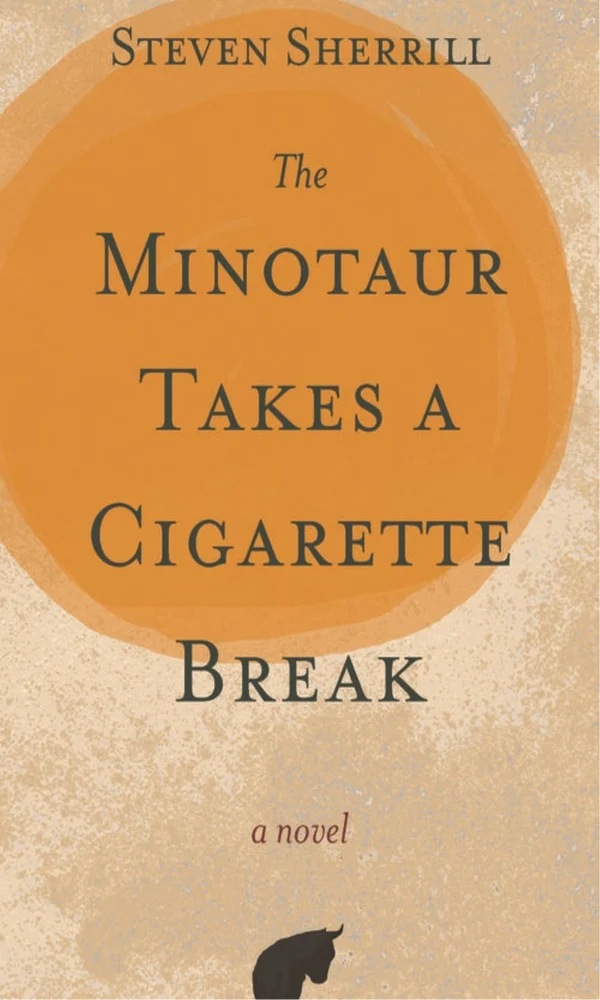
Review: The Minotaur Takes a Cigarette Break
Steven Sherrill
254 pages
John F. Blair Publisher (2000)
Read this if you like: Neil Gaiman’s American Gods, Haruki Murakami, Greek mythology
tl;dr summary: The Minotaur (yes, that Minotaur) works as a line cook and lives in a trailer in the American South.
I'm a sucker for stories that bring ancient mythology into the modern world, so I knew I needed to read this book the second I saw the title. What really hooked me into it, though, was the voice. The opening scene paints a very effective picture: the Minotaur on break, smoking a cigarette on an empty pickle bucket behind the restaurant where he works. The sparse yet specific description of the setting puts anyone who's worked in food service right there in the moment, showing the scene in a stark kind of realism. Then there’s beautiful lines like how the Minotaur describes his feeling for cigarettes: “The Minotaur doesn't like to smoke but smokes anyway, smokes menthols because he likes them even less.”
It's a depressing but evocative contradiction, and one that I think nicely encapsulates the Minotaur's worldview throughout the book. He continues to exist after 5,000 years, though he isn't completely sure why. And, while the years have changed him to a degree—he no longer eats human flesh, for instance—in other ways he remains a relic of his time, out of place in the modern world in a very painfully lonely way.
I've read plenty of other stories that incorporate mythological figures into modern, everyday life, but none of them take quite the approach that's used in The Minotaur Takes a Cigarette Break. Typically, they go in one of two directions. Either it's more of a send-up, with the ancient figure's oddities highlighted for comedic effect, or it's an action-adventure superhero kind of deal (or a combination of the two, a la American Gods). In either case, though, they nearly always lean heavily on the supernatural, magical aspect, where the ancient figures have power and abilities that humans don't.
Immortality is the Minotaur's only trait that could be seen as a super-power—and, for him, it's more of a curse than anything. When it comes to his ability to navigate the world day-to-day, he's really at a disadvantage compared to the humans. This book leans into the reality of what it would be to navigate the world as a human body with a bull's head. And, spoilers, it isn't great. His mouth isn't formed for speech, making communication difficult. He also lacks full peripheral vision and his horns are a potentially deadly annoyance. There are a few times that his non-human traits are used for comic relief throughout the book, but the overall tone of the book isn't a comedy. The main focus is on how the Minotaur's unique traits have contributed to his soul-aching loneliness. He is ultimately a tragic figure, a singular being who has roamed the world alone for thousands of years with no real purpose or companions.
I was also intrigued by the way the world was built around the Minotaur. The world-at-large seems to generally accept his existence without much comment. People don't run or scream at the first sight of him—some kids stare, here and there, and there are times he's mocked or ostracized, but this seems to be driven more by his difficulty communicating and the fact that he's different from others. The reactions to him seemed analogous to how many people respond to those with visible disabilities or deformities—he's othered, but in a muted way. Again, this isn't the approach I think most writers would take with it, but I found it a very smart choice. It gives the Minotaur potential to serve as a metaphor for a variety of things and makes him highly relatable for anyone who has ever felt othered because of their physical differences.
There were times I found the Minotaur's lack of motivation and self-awareness frustrating, but that's not an indictment of the book. I felt these moments were very intentional and authentic to the character as he's established. His primary flaw is that he hasn't managed to understand himself or the humans around him, despite having had thousands of years to figure it out. We can see that he's changed since his time in the labyrinth from his occasional flashbacks and ruminations on how he's mellowed. He doesn't respond to insults by goring and eating someone anymore, for instance, which arguably is positive growth. But this growth hasn't brought him any fulfillment. If anything, it reads more as a long-lingering depression; he's abandoned this violent identity, but never found a new one to replace it.
I tend to enjoy books that are difficult to classify into a genre, and that's definitely the case with this one. It's really a literary story at its heart, telling the tale of a sad, lonely man desperately seeking some kind of connection in a world that wasn't built for him. It just happens to be that this man is the Minotaur, a fact that adds layers of metaphor and expands the story’s world. If pressed to put a genre label on it, I'd call it “magical realism without the magic”—things are different from reality, but they're also painfully the same, and this book exploits the energy in that contradiction well.
See similar posts: