The Literary Publishing Pay Landscape
We were super stoked at After Happy Hour when we finally started being able to pay our contributors. It wasn't much at first—just a $10 token payment per contributor, which for us felt just on the good side of not insulting but still seemed manageable if we didn't bring in much revenue that reading period. What we found, though, was that once we started paying contributors our revenue went up, too. More people were willing to pay for expedited submissions, or throw us a few bucks as a tip jar submission, and we also started selling more print issues. All together, that meant we were able to increase our pay rates within just a couple years to where they are now.
Currently, After Happy Hour pays contributors $2.50 per issue page, with a minimum of $15 and a maximum of $50 per work. Functionally, this means we end up paying $15 per poem or work of art, with prose writers getting $15-$50 depending on the length of their work. That puts us into semi-pro territory for art and poetry, and we perch on the border between token and semi-pro payment for fiction and creative nonfiction depending on the length of the work.
For context of what I mean by these terms, I'm basing them off of Duotrope's classification system, which essentially reflects the industry standard. They break markets into 4 pay categories:
- Non-paying – No monetary compensation for contributors
- Token payment – Pays less than .01/word for fiction or creative nonfiction, less than $5 per poem, or less than $10 per work of art
- Semi-pro Payment – Pays .01-.05/word for fiction or creative nonfiction, $5-$49 per poem, or $10-$49 per work of art
- Professional payment – Pays over .05/word for fiction or creative nonfiction, $50 or more per poem, or $50 or more per work of art
I was curious, both as an editor and a submitter, about where After Happy Hour falls in the broader literary landscape in terms of our payment structure. So I decided to scrounge up some data and crunch some numbers to get a sense for what pay rates are across the literary journal world. And since I figured I'm not the only person who might find this info helpful, I put that data into some pie charts and decided to make a post about it.
All the data used in this post came from Duotrope. I used the Advanced Search for Publishers feature with contests excluded and temporarily closed markets included, so while it's not a fully comprehensive picture of the short fiction and poetry publishing landscape, it covers the majority of markets that are out there.
I should also note that when it gives an acceptance ratio, that's based on the user-reported stats on Duotrope. That means it's not necessarily completely accurate to what would show up on the editors' back-end for those markets since not every submission gets reported on Duotrope. That said, typically the real acceptance percentage will be lower than what gets reported on market databases, so something that's in the “under 10% acceptance percentage” category on Duotrope is most likely still in that subset of markets IRL.
On to the data!
Pay rates for short fiction publishers
Duotrope categorizes short fiction publishers according to the length of what they publish, which means that flash fiction (up to 1,000) is a separate category than short fiction (1,000-7,500). I started off by looking at each of these categories for both print and electronic formats to get a broad overview:
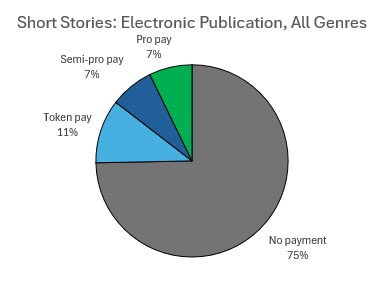
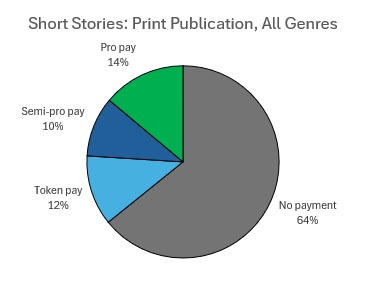
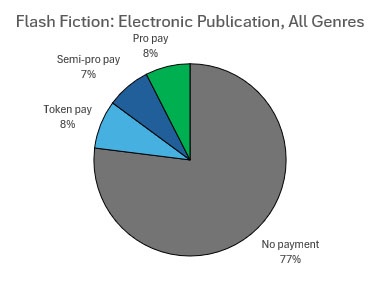
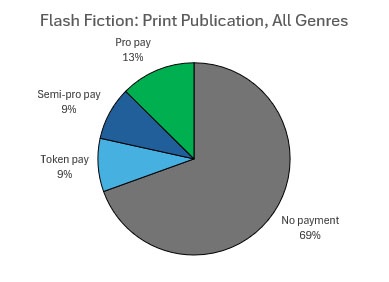
This confirmed a suspicion I had: you're slightly more likely to get paid by a print publication than an online one when it comes to short fiction. It was also a bit surprising to me, though, that the percentage of markets offering professional publication are about the same for flash as for longer short stories. I would have thought more markets would end up in semi-pro or pro territory for flash work, just since they're shorter. Instead, it seems to be the opposite. I imagine this is because more of the non-paying markets have a lower word count cut-off and that balances out the markets that pay a flat honorarium regardless of work, which would be the situation where a market would end up potentially paying pro rates for flash but semi-pro or even token for a longer piece (e.g. a $50 per story policy, which would be considered “pro” for a story up to 1,000 words, semi-pro for a 1,001-5,000 word story, and “token” for one that's 5,001+).
I had another suspicion based on my experience as a submitter: that the percentage of paying markets for genre fiction is higher than for literary or general publications. Here's what the data showed when I restricted the search to just fantasy or sci-fi:
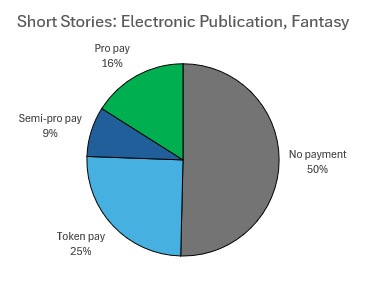
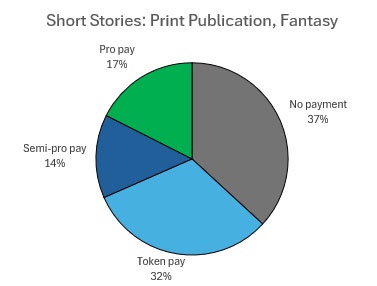
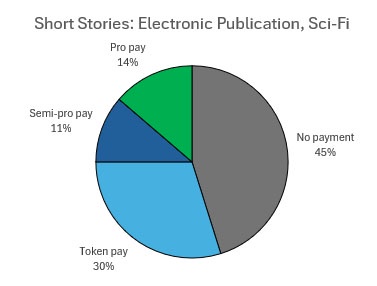

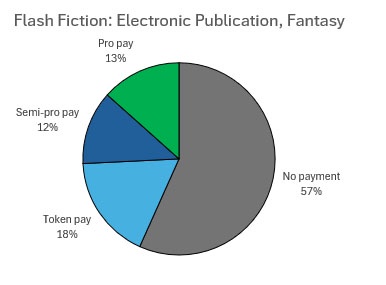
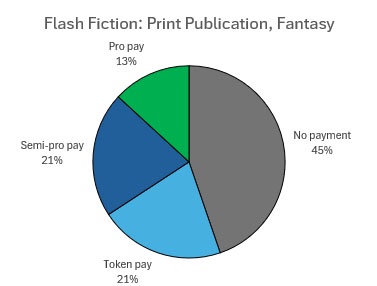
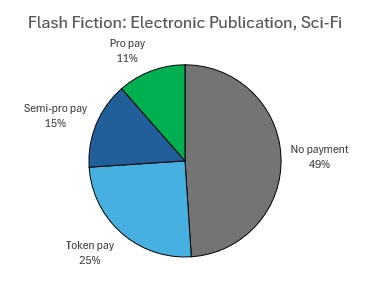
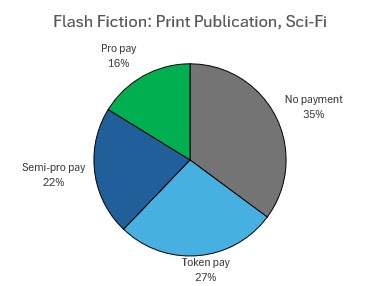
I would say these numbers partially confirmed my suspicions, though there were also some surprises. The biggest for me was the disparity between pay rates for sci-fi and fantasy—I had thought those would be nearly identical, but it seems as if there are more non-paying publishers in fantasy than there are in sci-fi. Thinking through why this might be, I suspect it's because fantasy is a broader genre and there are simply more markets that publish it compared to the slightly more limited category of sci-fi.
In either case, though, across both short stories and flash, the odds of being paid are higher in the genres than across all markets in general. Considering those sci-fi and fantasy publishers were also included in that overall stat, by extension we can infer that the percentage that pay for straight literary work are lower than what's presented here as the overall figures (since the genre-only publishers are giving the stats a wee boost).
The big picture takeaway here: you're the most likely to at least be paid something in a print sci-fi magazine, while fantasy has a broader spread, with slightly more non-paying markets as well as the highest percentage of markets paying pro rates across both print and electronic formats.
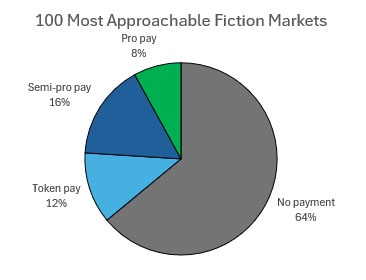
I also thought it would be interesting to break things down by acceptance percentage. Again, I had a suspicion going into this, which was that the markets with the lowest acceptance ratios would also be most likely to pay. So I started with Duotrope’s list of the 100 Most Approachable Fiction Markets (the ones with the highest acceptance percentages):
Then I shifted over to the markets whose reported acceptance percentage is 10% or lower, which is the rough cutoff point in my mind for what you might consider a “mid-list” publication:

Then I took that down to 5% or lower, which is where I mentally put my cutoff for “upper-tier” publications:
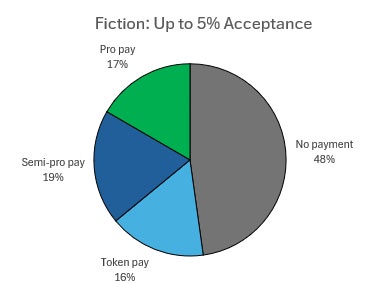
Then I took it down one more step, to a 1% acceptance ratio, which is generally my cutoff for an “elite” journal:

And finally I looked at the journals that appear on Duotrope's 100 Most Challenging Fiction Markets:
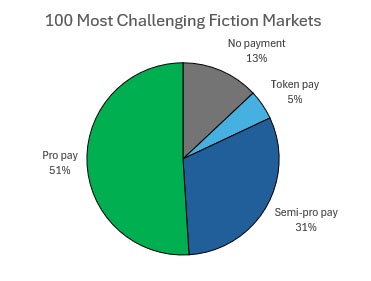
…I will say I was surprised by how similar the distribution was across the 10%, 5%, and 1% acceptance markets. I sort of assumed that the percentage that pay would gradually go up as the percentage of submissions accepted decreases. From the 100 Most Challenging breakdown, it’s clear that the majority of markets at the very top do pay (and typically quite well), but it seems that shift happens at a lower acceptance percentage threshold than 1%.
Something else I was curious about was whether you’re more likely to get paid from submitting to journals that have a submission fee. And, oddly enough, it actually seems like it’s the opposite:
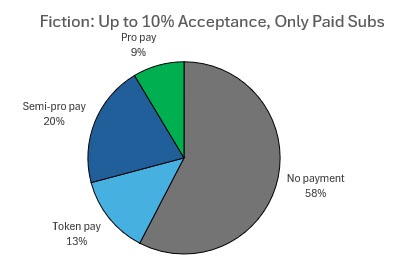
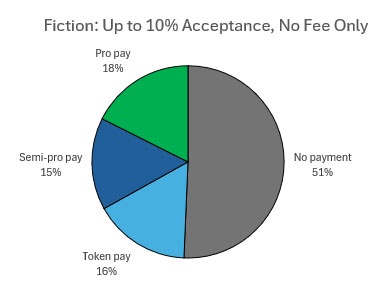
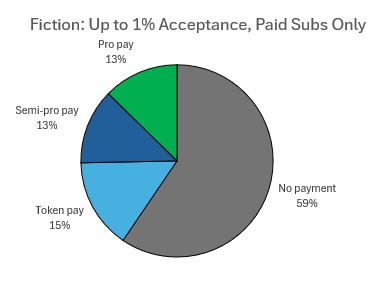
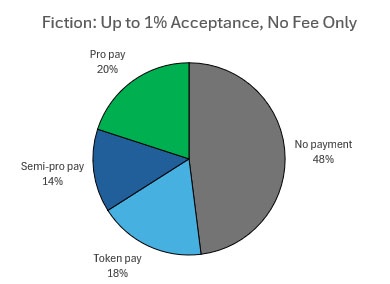
…which I feel like is representative of a deeper ill among certain types of literary publishers, and a topic that could warrant its own future blog post. Especially considering that over half of all journals with a 1% or lower acceptance percentage that require payment to submit don’t pay their writers. Considering the sheer number of submissions they must receive to have an acceptance percentage that low, it really makes you wonder exactly where all of that money is going if not back to the authors.
Pay rates for poetry publishers
I took the same approach to start with journals that publish poetry as with the fiction markets, breaking it down by electronic versus print publications:
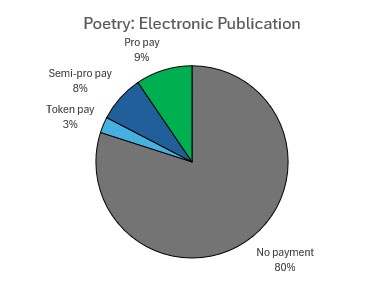
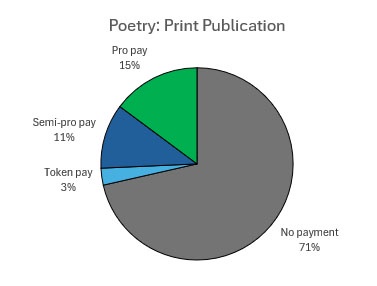
…this seemed to confirm a suspicion I had coming into my research: a smaller percentage of poetry markets pay compared to fiction markets. Checking out the numbers for Duotrope’s 100 Most Approachable Markets seemed to double down on this:
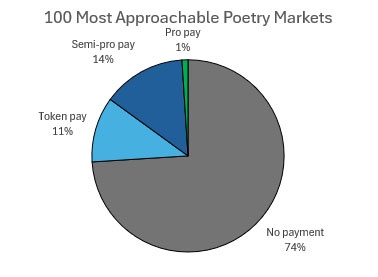
…but then I switched over to the markets with a 10% or lower acceptance rate, and the ratios started to look more familiar:
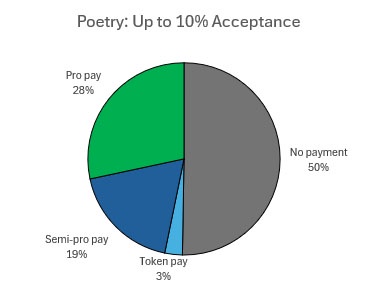
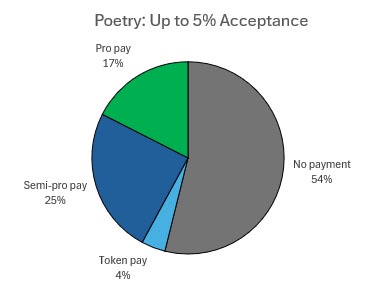
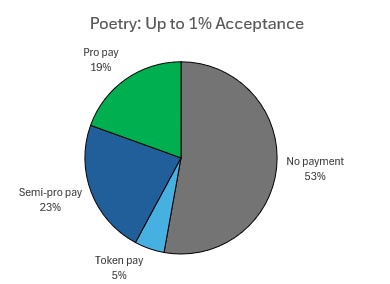
When you get up to the very top, then the balance shifts and poetry markets are again markedly less likely to pay contributors than fiction ones:
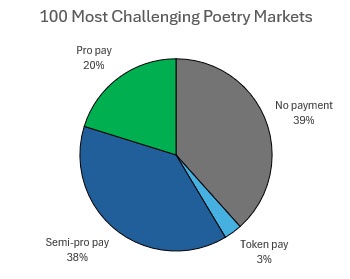
…but when you’re looking at the mid-range markets, all the way up through the lower end of “top tier” territory, the difference in pay rates between poetry and fiction publishers is minor. The biggest difference seems to be that there are fewer in the “token” pay range, which makes sense. For poetry, that’s something that pays but less than $5 per poem, which honestly gets down into the level where it’s almost not even worth it to send the payment for a single poem, depending on how you do it.
The other main difference I saw with the poetry markets was with how submission fees impacted the percentages:

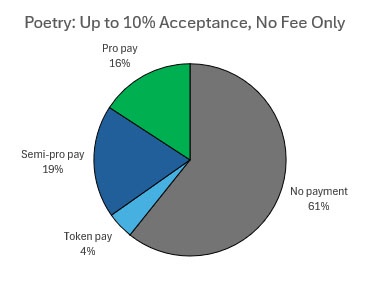


The difference is more pronounced when you take a broader view across mid-range and top-tier markets, which makes sense to an extent. A lot of those 1% or less acceptance journals have such a reputation that a lot of people will pay to submit to them for the prestige of potentially getting published there, even if they don’t pay (not that I think that’s fair, but I can see the thought process of submitters). But at least the majority of poetry publishers that charge submission fees send at least some of that money back to writers, which is heartening.
So what’s it all mean?
I think there are heartening and disheartening takeaways from this data. On the positive side, there are definitely plenty of markets out there that are compensating writers well for the words they write, and not all of them are white whales (although the whales are, on the whole, the most likely to pay professional rates).
The most disturbing insight, to me, is the fact that charging submission fees without paying writers has become such a widespread practice. I suppose I had naively assumed it was something reserved to a few university affiliated literary journals, but these numbers suggest that's not the case. As the editor of a literary journal, I completely get that publications need to do something to keep the lights on, but if it's writers financing said lights it only seems fair to me that they stand to see some kind of benefit from that if their work is published.
I would be curious to dig deeper into some of these stats, and see how pay ranges break down based on factors like whether the journal is university affiliated or what year it was founded. But this at least gives a big-picture overview of how lit mags are paying writers, and hopefully it's interesting and/or useful for other folks out there.
See similar posts: