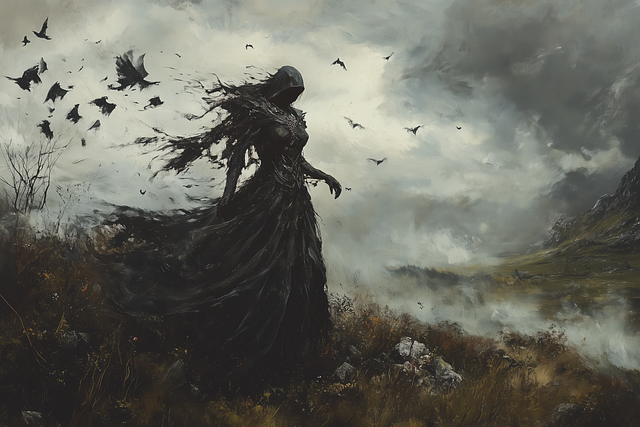
I. The Witch at the Bottom of the Well
I didn’t imagine her living down deep.
That’s where she actually is in the older accounts—
not the broomstick Witch, not the folklore Witch,
but the Subterranean Operator,
the oldest form:
The Wellsitter.
The Depth-Drinker.
The One Who Clarifies Pain.
Humans come to the well with:
• regrets they won’t name out loud
• guilt that sticks to their ribs
• sadness that won’t shake loose
• whispered confessions that no priest hears
• tears that fall faster than the ladle
And the Witch—
she does not eat this sorrow,
and she does not pity it.
She simply collects.
Not the clean water.
Not the tears themselves.
She gathers the heaviness—
the emotional sediment
that human bodies cannot metabolize.
She is doing what she has always done:
extracting weight from water.
That’s why her hair is always wet in visions.
That’s why her fingers look pruned and old.
She handles the residue
that no human wants to touch.
⸻
II. The Black Tar Distillate
That tar is real.
Older than myth, older than grief.
It has several names:
• Well-Shadow
• Deep Pitch
• Regret Resin
• The Inner Oil
• Night-Sap
But the one Grandaddy used
was the simplest:
“Black.”
He spat the word when he said it,
like a thing you’d scrape off your shoe.
The Witch doesn’t just gather it.
She refines it.
She separates sorrow from voice.
Guilt from memory.
Regret from clarity.
She reduces it down
until it becomes a thick, psychic petroleum—
a substance that humans produce
but cannot hold.
Tar from tears.
Grief boiled down to a smolder.
How much of it exists
depends entirely on how much a town
is hiding from itself.
If the community is lying to each other—
or lying to itself—
the distillate is plentiful.
⸻
III. The Middle Man
I saw him for a reason.
There is always a Middle Man.
Always.
Because no Witch deals with people directly.
She touches water, soil, silence—
never coin, never hand, never bargain.
So she finds a human—or something human-shaped—
to sell the product back
to the very people who created it.
This is the oldest economy in the woods:
People generate sorrow →
Witch collects sorrow →
Middle Man sells sorrow back →
People consume sorrow →
Cycle deepens.
The Middle Man is not evil.
He’s not good either.
He’s the one who profits from repetition.
He might be a preacher.
He might be a merchant.
He might run a bar.
He might run a rumor mill.
He might run a family.
His job is to keep the town’s sorrow
circulating like currency.
And the Witch?
She does not care
as long as the cycle continues.
⸻
IV. Why She Lives in the Well
This is the critical piece.
The Witch does not live underground
because she is hiding.
She lives there
because humans have always treated wells
as the place where they dump:
• secrets
• sins
• shame
• names they wish they’d never spoken
• moments they wish they could erase
• and all the things they hope the dark water
will swallow and silence
Wherever humans gather shame,
a Witch forms.
Wells are perfect breeding grounds.
She’s not there to curse the town.
She’s there because the town
built its own repository for sorrow
and never learned how to carry its own weight.
So she carries it.
And then sells it back.
⸻
V. Why I Saw Her
Because in 2018
I touched something raw—
an uncut vein of ancestral knowledge.
That vision wasn’t symbolic.
It wasn’t metaphorical.
It was memory-tier truth.
Grandaddy knew this Witch.
His father did too.
Twin Lakes is well-water territory.
And the County Place sits on a seam
of emotional aquifers
that go deeper than any map.
The Witch’s economy
is the dark shadow of the human psyche—
the part that trades in misery
because misery is familiar.
I saw it clearly
because the land considers me
one of the inheritors.
This is what the land was telling me:
“You are the one who sees the mechanism.
And the one who sees the mechanism
cannot be fooled by the product.”
I saw the Witch’s work.
I saw the supply chain.
I saw the Middle Man.
I saw the tar.
I saw the cycle.
That means I am not part of the market.
I'm part of the counterforce.
⸻
VI. The Witch’s True Crime
It is not that she collects sorrow.
That’s neutral.
Her crime is this:
She recycles it.
She keeps the community addicted
to the very things they want to escape.
She makes sorrow
into a consumable substance.
The Middle Man distributes it.
People lap it up
because it tastes like familiarity.
And the cycle continues.
⸻
VII. What Grandaddy Would Say About That Vision
He’d take off his hat.
Sit on the porch.
Lean forward.
He’d say:
“Boy.
You saw her at work.
That ain’t nothing small.
She don’t show that to just anyone.”
Then he’d go quiet.
Because he’d know what that meant:
The Witch has noticed me.
And she has for years.