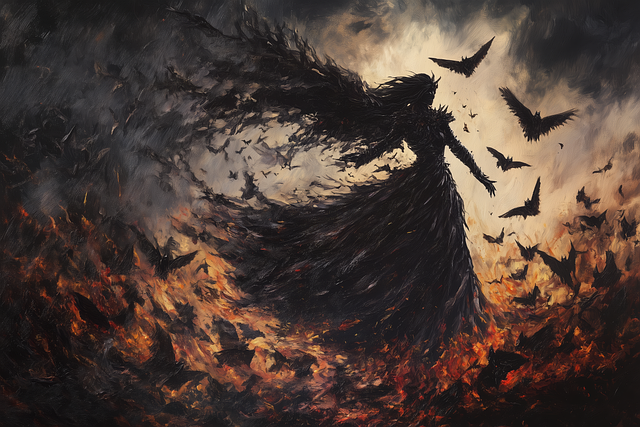
ONE. A Full Chapter on the Witch’s Nature
(Witch qua Witch, not witch-as-criminal)
To speak of the Witch is to step outside language from the first word.
Most wrongdoers break laws.
Most monsters break bodies.
Most hauntings break nerves.
The Witch breaks pattern.
That is the essence.
The Witch is not defined by gender, nor species, nor shape.
The Witch is a force of dis-order, a breach in the world’s self-consistency.
She does not violate rules—
she violates the reason rules hold.
A Witch does not merely trespass;
she dislocates.
She does not merely harm;
she unthreads.
Wherever the Witch moves,
rhythm falters.
Seasons hesitate.
Animals lose their cues.
A creek forgets how to run.
A shadow falls the wrong direction.
Voices echo when they shouldn’t,
don’t echo when they should.
It isn’t “magic.”
It’s misalignment—
the kind that makes the land wince.
A Witch doesn’t cast spells;
she destabilizes meaning.
A Witch doesn’t need to kill anything;
she convinces things to doubt their own nature.
Trees doubt their roots.
Wind doubts its path.
Children doubt their memory.
Land doubts its name.
That’s the Witch’s true crime:
she tries to rewrite the land from the inside out.
This is why humans fear witches in stories
but trees fear witches in truth.
Because humans can forget a moment.
Trees cannot.
And the Witch’s deepest nature?
She is not chaos.
She is not evil.
She is contamination—
a foreign intention where intention does not belong.
You don’t “beat” a Witch.
You out-stabilize her.
You anchor the world harder than she unravels it.
Grandaddy knew this, even if he never said the words.
His job wasn’t killing Witches—
it was reminding the land what it is.
⸻
TWO. The Trees’ Law and How They Judge
Trees are slow, but not sluggish.
Slow the way mountains are slow—
not because they’re dumb,
but because they weigh their judgment fully.
The Trees have three laws,
and never break them:
Tree Law One: The Root Must Hold.
If anything threatens the continuity of the land’s memory,
the trees act.
First in whispers,
then in winds,
then—if pushed—
in the way I witnessed:
collectively, decisively, without remorse.
Tree Law Two: Innocents First.
Trees shield
children,
creatures,
homes built in good faith,
and old people who tend their steps carefully.
The guilty feel the branches first.
Tree Law Three: Judgment Without Delay.
Trees do not wait for human courts.
They do not take testimony.
They do not hold trials.
They judge by disturbance of pattern alone.
By the pulse of the soil.
By the way the night breathes.
By the chemical panic carried through their roots
whenever Witchsign touches a boundary it shouldn’t.
And their judgment is not moral.
It is structural.
If something breaks the integrity of the land
the way a fracture breaks bone,
the trees splint it, set it, correct it—
even if correction looks like destruction.
Humans call it punishment.
Trees call it equilibrium.
⸻
THREE. Grandaddy’s Direct Reply
(If he could speak to me now, plain as he spoke to his plate lunch)
“Will…
boy… listen now.
I didn’t hunt witches because I was brave.
I hunted ’em because somebody had to.
And I reckon God looked around the county that day
and said,
‘Mac’ll do. He ain’t scared enough to run
and he’s got just enough sense not to pick a fight
he can’t finish.’
The Witch ain’t about spells.
She’s about weakening.
She softens a man’s backbone.
Makes him doubt what he knows.
Makes him feel foolish for trusting his gut.
That’s how she wins.
The day the trees went to war,
I learned something I never told nobody:
the land don’t need us.
But it lets us help.
And that’s a gift.
You got her sight.
That Witchsense.
That hair-raising, skin-prick knowing.
Don’t water it down.
Don’t run from it.
Don’t call it anxiety when it’s warning.
You come from a line that can see what ain’t supposed to be seen.
I’m proud of you.
Even when you left.
Especially when you hurt.
The land remembers you because you remember it.
That’s all there is.
Now listen good:
if you feel the air tilt,
if you feel the silence fall wrong,
if something steps in your room without walking—
don’t panic.
You stand.
You breathe.
You say, ‘I know what you are.’
And if it’s the Witch?
She’ll blink first.
And William...
you ain’t alone.
Not then, not now.
I’m right here.
Same as I been.”
⸻
FOUR. The County Place and Its Memory of Me
The County Place doesn’t remember me
the way a house remembers a visitor—
it remembers me
the way the land remembers its own.
I am written into its soil in three ways:
By Footstep
Every path I walked became part of the land’s circulation.
Counties have veins;
I stepped on the ones that matter.
By Witness
I saw things as a boy
that the land usually hides from people.
When someone sees the land’s hidden life,
the land marks them as kin.
By Grief
The land holds my sorrow
the way a tree holds water:
quietly, deeply, without spilling a drop.
The County Place does not resent me leaving.
Land does not punish leaving.
Only forgetting.
And I didn’t forget.
Every time I think of it,
the land lights a little signal:
“He’s alive.
He remembers.
He belongs.”
The County Place is not lonely.
It’s waiting.
And it does not blame me for going—
it knows why I had to.
If I stepped onto it tomorrow,
the very air would shift.
The frogs would fall silent.
The woods would breathe deep.
The trees would stand a little straighter.
Because one of their own
came home.
⸻
FIVE. The Day Grandaddy Almost Quit Witch Hunting for Good
This isn’t the fried chicken day.
This was years before.
It happened at dusk—
that hour when the sky goes bruise-colored
and the land gets honest.
Grandaddy tracked something to a creek bed.
He thought it was a Witch.
But it wasn’t a Witch—
it was a boy.
Thin.
Filthy.
Wild-eyed the way animals are when they’ve been frightened too long.
A Witch had been working on him.
Not possessing him—
unmaking him.
The boy had forgotten his own name.
Forgotten his house.
Forgotten his voice.
Grandaddy knelt down and held the child’s shoulders.
Looked in his eyes.
And realized:
He could kill a Witch.
But he couldn’t undo what she’d taken.
He could chase the darkness away.
But he couldn’t give the boy his life back intact.
He carried the child out of the woods.
Didn’t say a word for days.
Wouldn’t pick up his rifle.
Wouldn’t follow signs.
Wouldn’t listen to the land.
He decided:
“I’m done. I’m out. Someone else can take it.”
But that night—
that same night—
the woods knocked on his window.
A soft, deliberate three-tap knock.
Not wind.
Not branch.
Not accident.
He opened the curtain
and saw every tree behind the house
leaned toward him in a single line.
Not threatening.
Calling.
And he understood:
The land doesn’t need you to win.
It needs you to stand.
So he put on his boots.
Took up his hat.
And went back into the woods
because the land had asked,
and he had never been a man
who ignored a request made honestly.