Pixels, atoms, and curious things: A toast to the Virtuous Museum Circle
The evidence is as clear as it is surprising (to some): Easy online access to museum collections makes them all the more interesting to see offline. What have we done to deserve this miracle?
 Pieter Aertsen, The Fat Kitchen. An Allegory, 1565–1575. SMK — Statens Museum for Kunst.
The British Library have spelled it out:
The more screen-based our lives, it seems, the greater the perceived value of real human encounters and physical artefacts: activity in each realm feeds interest in the other.
A part of you is thinking “sure, of course, we knew that.” But stop, take a deep breath and think about it. Because, of course, we didn’t really know this. Some of us surely suspected it. But much open access rhetoric has rested upon a rather different premise: That the public had a right to choose their channels and that museums should seek to maximize their influence (or “reach”) by leveraging the potential of web access. The implication here: Physical visits shouldn’t actually be factored in. If, hypothetically, online views hurt visitor numbers then that should not deter us from fulfilling our digital potential.
A part of you is thinking “sure, of course, we knew that.” But stop, take a deep breath and think about it. Because, of course, we didn’t really know this. Some of us surely suspected it. But much open access rhetoric has rested upon a rather different premise: That the public had a right to choose their channels and that museums should seek to maximize their influence (or “reach”) by leveraging the potential of web access. The implication here: Physical visits shouldn’t actually be factored in. If, hypothetically, online views hurt visitor numbers then that should not deter us from fulfilling our digital potential.
The beauty is this: Not only does digital not hurt physical, they enforce each other. Or as a recent Montreal Gazette headline simply stated: “In a digital age, more people than ever are visiting libraries, archives and museums”.
In no year previous to 2015 had the SMK been more digital and in no previous year did the museum see more physical visitors [link no longer active] (2016 numbers were lower but that year saw the introduction of paid entrance).
The Rijksmuseum, in the absolute openness avantgarde, have largely concluded that open access has been a great advantage and saw record (physical) attendance in 2014. As one Europeana study concluded:
Combined with the enormous exposure, reputational benefits and the ability to enter more cost-effective sponsor programmes greatly outweighed the reduced images sales for the museum
And while there are surely all sorts of variables and things that can go wrong, studies that have aggregated museum experience with open access tend to report substantial satisfaction. See for instance Effie Kapsalis’ recent The Impact of Open Access on Galleries, Libraries, Museums, & Archives and Kristin Kelly’s 2o13 report Images of Works of Art in Museum Collections: The Experience of Open Access [link no longer active].
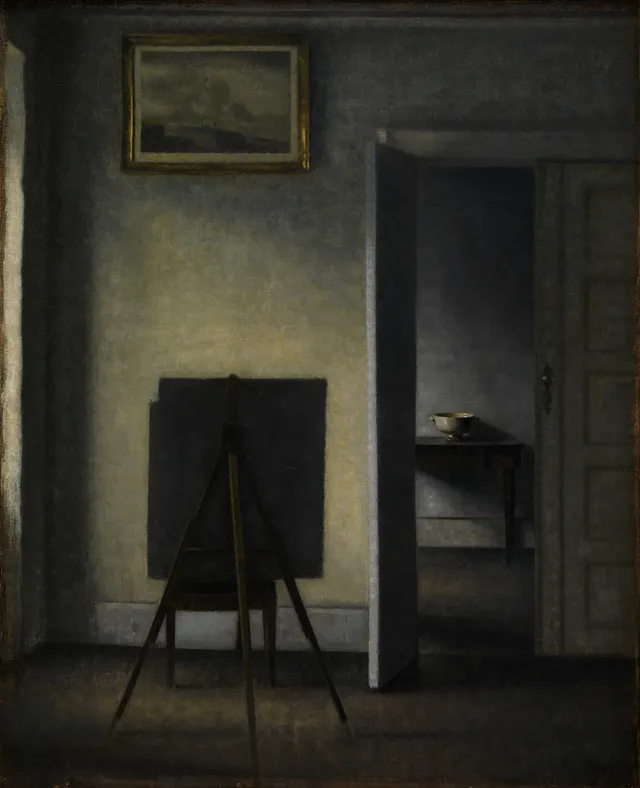
Vilhelm Hammershøi, Interiør med kunstnerens staffeli, 1910. SMK — Statens Museum for Kunst.
It is now more than fair to say that, for museums, the curves align. If you’re able to generate interest in your collection in one space, then that interest extends to other spaces. If you see an SMK Hammershøi online, you’re more likely — not less — to want to see the real, physical thing.
Let’s take that even further. For museums, the more press interest you generate, the more social media followers you are likely to attract, the higher your attendance will be, the more online views you’ll get. It’s all positively related. If you’re in publishing or in the movie business such relationships are much more complicated (not to say depressing). Really, this virtuous museum circle is a small miracle and if it doesn’t make digital museum workers happy every day, I don’t know what will.
This is not, obviously, to say that museum strategy is a complete no-brainer. There’s still limited budgets and many goals beyond visits and views. Conservation, research, security etc. are not so neatly (or ‘directly’) linked to public enthusiasm. Your Instagram views and your conservation resources are not, let’s be honest, co-dependent.
But worrying that everything is not aligned sounds spoiled. To have online views tied positively to physical attendance and thus to see how fulfilment of high-level goals of sparking interest in one’s collection (if handled elegantly) can go hand in hand with revenue generation is a gift that our digital counterparts in many other sectors would die for. As one of my ex-colleagues used to say: “With this development it’s hard work to stay gloomy.”