🧠 Declarative Differential Models (DDM) redux
This blog has previously defined DDM, in this post we restate the technique using parameter sweeps.
- Declarative: You specify what the system's relationships and constraints are, not how to compute them.
- Differential / DAE-based: The model is encoded as systems of differential equations (continuous or hybrid dynamics).
- Constraint Embedding: Physical or logical constraints are baked directly into the equations.
- Optimization-Ready: Structured for tuning via learning or direct optimization
Natural Fit with Parameter Sweeps
- Declarative Parameter Grids
You can define a range of parameter values (e.g., rate constants, capacity limits, initial markings) at the modeling level, without rewriting procedural logic.
   juliaCopyEditrates = [0.1, 0.5, 1.0]
   initial_tokens = [10, 20, 50]
Automatic System Instantiation
For each (rate, initial token) pair, a new DDM instance is formed—no manual recoding needed.Batch Simulation via DAE Solver
These are solved continuously over time using tools likeDifferentialEquations.jl.Constraint Enforcement Across Variants
All parameterized runs still respect embedded constraints like conservation laws, regardless of parameter selection.Optimization and Sensitivity
You can trace the outputs (e.g., token flow, system performance) over the parameter sweeps, enabling:- Sensitivity analysis
- Finding thresholds or tipping points
- Hyperparameter tuning for optimal behavior
✅ Why It’s Powerful
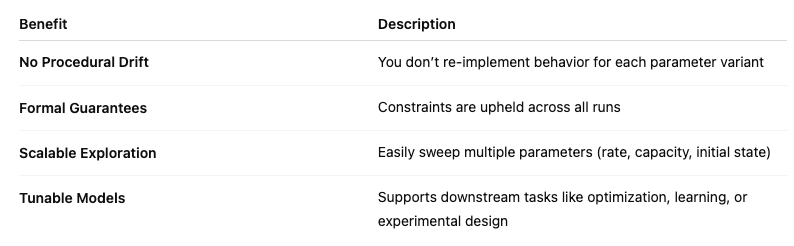
🔧 Example Use Cases
- Tic‑Tac‑Toe continuous model
- Sweep rates of possible moves and initial advantage tokens
- Observe how win probabilities shift over time
- https://gist.github.com/stackdump/06e7ccc96dd08b478b0da781a88c8d7a
- Knapsack optimization via Petri net ODE
- Sweep item weights and values to see which configuration maximizes reward under flow dynamics
- https://gist.github.com/stackdump/af151355d414491ac2eff9160e134892
- Workflow/Petri contract design
- Sweep transition rates or capacity constraints to tune responsiveness vs. safety in governance or escrow nets
🧩 Bringing It Together
DDM + Parameter Sweeping lets you:
Declaratively define a dynamic system (with constraints).
Parameterize aspects you want to explore or optimize.
Run batch DAE simulations under each parameter set.
Analyze results for sensitivity, tuning, verification, or learning.
With the added enhancement of parameter sweeping terminology, we embrace a fully declarative and continuous modeling paradigm—no reinventing the wheel for each variant.