Sports gambling is a bad bet, especially for sports
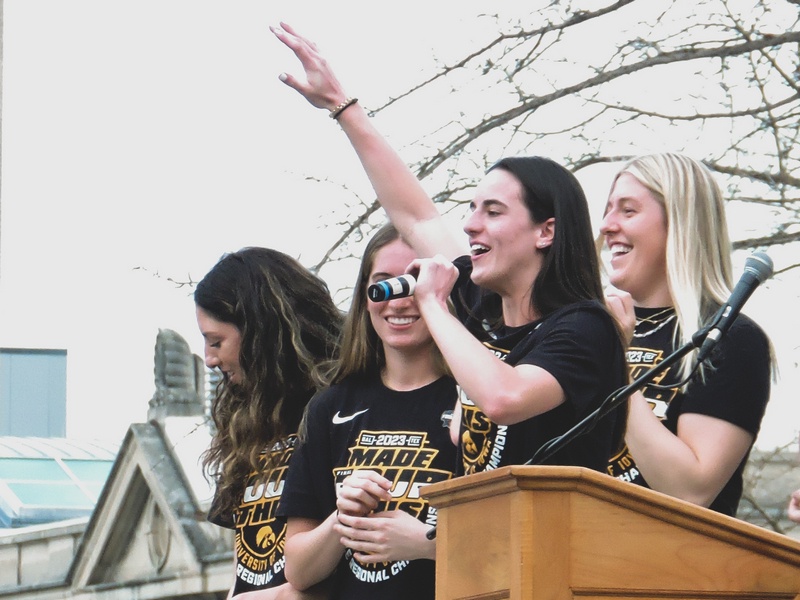
Caitlin Clark and women’s basketball teammates at a University of Iowa campus rally, 14 Apr. 2023. (Photo: A. Kotok)
Alan Kotok, CEO, Technology News and Literature (technewslit.com)
15 Sept. 2025. Sure, sports are a business and have been for a long time, but betting on sports is a business nobody needs, particularly the athletes themselves. A batch of new cases this month shows how betting is perverting the sports it targets. And one of my recent photoshoots shows how the rapid spread of gambling now worries those in charge of the play.
If sports can generate big money, that's fine. Sponsorships, naming rights, merchandise sales, and endorsements bring in more revenues for teams and leagues at all levels. And why not? Sports are a form of entertainment, and people putting on the show deserve to be paid.
What makes sports entertaining is the athletes' skills and performance. Caitlin Clark's play in college and the pros has brought millions of new fans to women's basketball, and she deserves every dollar earned in pay and endorsements. Clark of the WNBA Indiana Fever is celebrated not only for her dead-eye shooting from almost anywhere on the court, but also for the way she plays the game, finding teammates and feeding them the ball in the split-seconds they're open. (Disclosure: Clark went to University of Iowa, where I got my B.A. degree, but in a previous century.)
More bettors are players' friends and classmates
In the past few years, however, legalized gambling has intruded so much on sports that it's obstructing these athletes' performances. All but a handful of states in the U.S. have some form of legalized gambling, according to USA Today. Plus, many of the avid sports gamblers now are young. American Psychological Association in 2023 cites research showing the fastest-growing group of gamblers are people in their early 20s, with many kids starting even younger than that.
Thus, the fastest-growing group of gamblers are about same age as the athletes playing the sports where bets are placed. And the problems here are obvious. Many sports bettors can be acquaintances, friends, or relatives of the athletes, or even the athletes themselves.
NCAA president Charlie Baker, former governor of Massachusetts, in an interview that I photographed at the National Press Club on 24 July 2025, came down hard on sports betting. The interview with Associated Press reporter Tara Copp dealt largely with tournaments, conferences, transfers, and financial issues like name-image-likeness payments. During much of the program, Baker was relaxed and smiling. But when sports betting came up, Baker's demeanor turned dead serious — see photo— and he shifted forward in his chair.
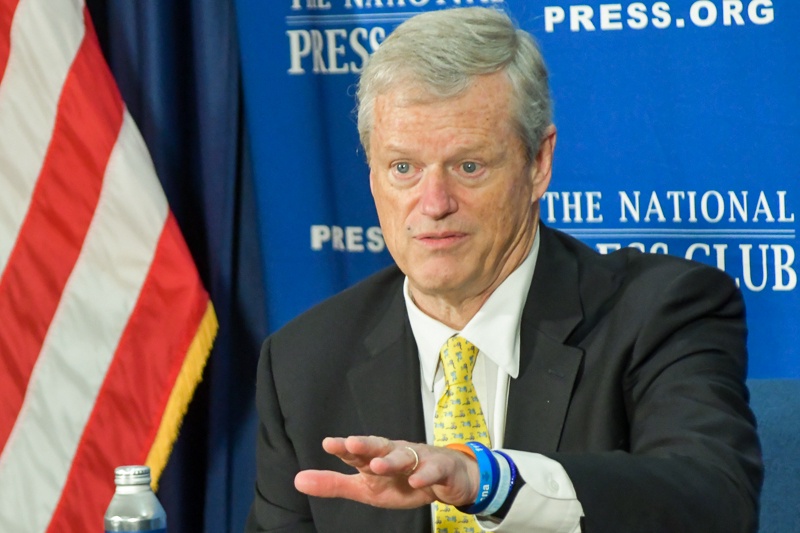
NCAA president turned dead-serious when the subject of sports betting came up in his 24 July 2025 interview at the National Press Club. (Photo: A. Kotok)
Baker told how prop bets, short for proposition bets, are turning college athletes into objects of hate from bettors. Prop bets are wagers on outcomes other than game winners, losers, or point spreads: for example, points, hits, catches, tackles, or sacks by specific players, called player props. Baker told Copp how fans losing prop bets at college basketball games yell abusive comments at players on the court.
Also in that interview, Baker warned against the prospect of athletes helping friends or even themselves win prop bets. That prospect became a reality on 11 Sept. 2025 when the NCAA charged 13 former college basketball players at six schools for “betting on and against their own teams, sharing information with third parties for purposes of sports betting, knowingly manipulating scoring or game outcomes and/or refusing to participate in the enforcement staff's investigation.”
These charges followed findings a day earlier by NCAA of sports betting violations against three college basketball players at Fresno State and San Jose State in California.
In the NCAA’s 11 Sept. statement, Baker blamed prop bets for much of the problem and called for their elimination. “The rise of sports betting is creating more opportunity for athletes across sports to engage in this unacceptable behavior,” he noted, “and while legalized sports betting is here to stay, regulators and gaming companies can do more to reduce these integrity risks by eliminating prop bets and giving sports leagues a seat at the table when setting policies.”
The house always wins
If there are winners in sports betting other than the gambling operators, they're hard to find. NYU business professor Scott Galloway says winning gamblers may gain some money, but they also get a dopamine rush when their bet comes through. Plus, says Galloway, gamblers get a rush from the anticipation of winning, even if the bettor loses, which encourages more risk and more betting.
Moreover, says Galloway, gambling addiction is easy to hide, since there aren't the physical manifestations seen in alcohol or drug addictions. Nonetheless, says Galloway in Feb. 2024, “at least 6 million to 8 million U.S. adults are estimated to have a mild to severe gambling problem, costing the economy $7 billion,” with calls to gambling addiction hotlines doubling every year where sports betting is legal.
And the people most engaged in sports betting are young men, a group in growing crisis from loneliness, obesity, academic failure, addiction, and incarceration that Galloway has documented many times over.
You want to gamble? Go to a casino. But leave our sports out of it.
Update. 26 Sept. 2025. The interviewer, Tara Copp, is now a reporter for the Washington Post.
Copyright © Technology News and Literature. All rights reserved.