Consider the Hands
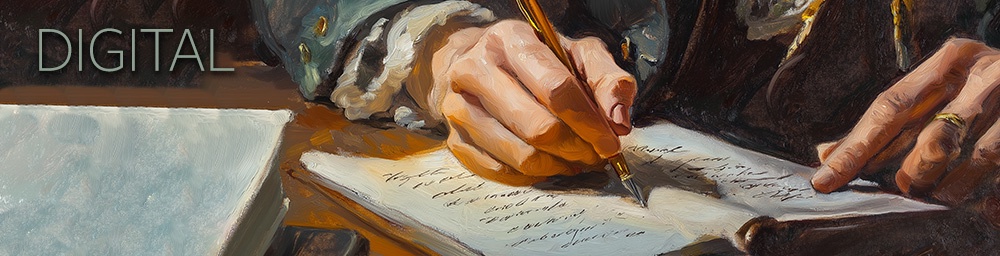
I lifted this from Poetry Unbound by Ó Tuama, Pádraig
For many years, I kept a correspondence with a friend, Brian. He'd moved to work in the far north of Canada, a place accessible only by plane. Every two weeks, supplies would be flown in together with post. “Can you make sure there's a letter for me on those planes?” He asked. Both of us loved poetry and often the letters contained copies of poems we were working on. I've kept all those letters. I could recognize Brian's handwriting anywhere.
Consider the hands that write this letter.
Arise – Aracelis Hermanni, after Marian Wilson.
Consider the hands that write this letter.
Left palm pressed flat against the paper.
As we have done before over my heart.
In peace, a reverence to the sea.
Some beautiful thing I saw once, felt once.
Snow falling like rice flung from the giant's wedding.
Or strangest of strange birds.
And consider then, the right hand
and how it is a fist, within which a sharp utensil.
Similar to the way I've held a spade.
The horse's reins loping the very fists
I've seen from the roads through Lemay and Esteli.
For years, I've come to sit this way.
One hand open, one hand closed.
Like a farmer who puts down seeds and gathers up.
Food will come from that farming.
Or yes, it is like the way I've danced
with my left hand upon an open shoulder,
or my right hand closed inside of another hand.
And how I pray, I pray for this to be my way.
Sweet work alluded to the body's position to its paper.
Left hand, right hand.
Like an open eye, an eye closed.
One hand flat against the trapdoor,
the other hand knocking, knocking.
The setting for this elegant poem is a poet at a desk or table writing. Her left hand is open, pressed on the table. Her right hand is a fist within which a sharpened utensil, a pencil. What is she writing? A letter, the title implies. But a letter to whom? Herself? Her future? Someone else? Could it also be a poem? Consider the Hands that Write this Letter is a poetic self-portrait of the artist at work. The focus is of active writing. And while much about the speaker's life is referenced, her love of the sea, snow, birds, horse riding, travel, dancing, these details are not the final point of the poem. Rather, the poem is interested in the poet as they write. What's
happening? What are they doing? What they're resisting, what they're holding together. Writing is physical, and the poem's focus is activity of hands during the act of writing. The push and pull of energy, the tension created and sustained for creative purposes.
When a person writes by hand, Aracelis Hermanné suggests in this poem, they place one open hand onthe table just like a person might have a hand placed on the heart while watching a beautifulsunset, and the other hand is closed, like when they've held a spade, the horse's reins. The open hand indicates receptivity. The closed hand has work to do. These two hands are not separate, of course. They're the body of the speaker.
The poem joins these two hands together. Looking at a person dancing, a person praying, open-handedness and close-handedness. An open eye, a close eye. Waiting and working, all of these things are contained in the body. A poem about poetry is called Ars Poetica, a term referenced a poem written by po- Roman poet Quintus Horatius Flaccus, 65 to 68 BCE, also known as Horace.
His Ars Poetica, a letter poem written in strict form, is an introduction to the art of poetry. Writing it, reading it, learning how to describe the art of it. All of his subsequent poems about poetry are gathered under the title of Horace's Ars Poetica. Sometimes such poems are about the idea of poetry. Sometimes, as in Aracelis Hermanné's poem, they're about the very act of writing poetry.
What requires from a person and their body? I sometimes worry that writing about writing can run the risk of separating the world into those who do and those who don't. However, Aracelis Hermanné doesn't fall into that trap. Consider the Hands that Write this Letter sees poetry as just one of the modes of evolving open-hand, close-hand postures. The speaker in this poem invites readers to notice resistance and desire in their bodies, and to notice the necessary tensions involved in going
about even the most everyday of tasks. Parenting, being in love, going to work, being alone.
The poem's interesting... The poem's ending is arresting. One hand flat against the trapdoor, the other hand knocking, knocking. What trapdoor? It's a courageous thing to add a new image in the final lines of a poem. The trapdoor is the page, and the speaker of the poem both curious and cautious about what's beneath it.
Why would you knock? The hope that something will respond.
What would that be? A story? Another self? Something locked away? Some unresolved thread of self that needs to be expressed? Seething or something that should be r- dead? Something that should be dead? This is a poem of great elegance, even gentleness with images of dancing and beauty. But it's also a poem of wildness, horses, strange birds, sharp blades to sharpen pencils. We hear that the project of writing unlocks things you might have put away. Those voices you have may have wished to quiet be heard. It gives language to that which may have been unconscious.
In The Game of Hide and Seek, the British child psycho- psychoanalyst D.W. Winnicott wrote, “It is a joy to be hidden and a disaster not to be found.” I find myself thinking of this phrase whenever I think about Aracelis Hermanné's trapdoor.
Something is hiding and the, and is seeking to be found.
There's a playfulness, a riskiness, a curiosity, a danger in the process of seeking that which has been hidden.
I love the image of a poet pushing with one hand and pulling with the other.
Underneath this poem is the question, why?
Why does a person feel the need to write? The speaker in this poem is opening and closing at the same time.
It's in the telling yet not telling tension that's at the heart of communication. This isn't about craft or editing. The energy of this poem is about knowledge. The knowledge of how much of your writing can reveal of you, how much it can feel like a necessary risk.
For years, my partner Paul and I have run a storytelling night in Belfast.
We chose a theme and invite people to submit a true story from their own life on that theme. The event is not aimed at professionals. It is aimed at people who have something they wish they could tell, something true.
Once a man who was due to tell a story asked to speak to me before the event. “I'm not sure if people will accept me. Will they hate me?” I'd read the story and knew the audience would love him. I assured him as best I could, but I knew that his worry was something deeper than performance anxiety. He too had one hand opening, one hand closing. He'd been compelled to write something from his life, and he knew he was revealed in what he'd written.
His resistance, in turn, revealed that he'd done the true work of writing.
He was on both sides of the trapdoor. Aracelis Hermanné is too, knocking and holding, wondering what's inside, wondering how to contain it or release it. Her words come from the outside and the inside. She's praying and the answer to her prayers, she's the one knocking, she's the one opening.

WolfCast Home Page – Listen, follow, subscribe
Thank you for coming here and walking through the garden of my mind. No day is as brilliant in its moment as it is gilded in memory. Embrace your experience and relish gorgeous recollection.
Into every life a little light will shine. Thank you for being my luminance in whatever capacity you may. Shine on, you brilliant souls!
— Go back home and read MORE by Wolf Inwool
— Visit the archive
I welcome feedback at my inbox