The Long Harvest
After the fire and flood, the gardeners returned.
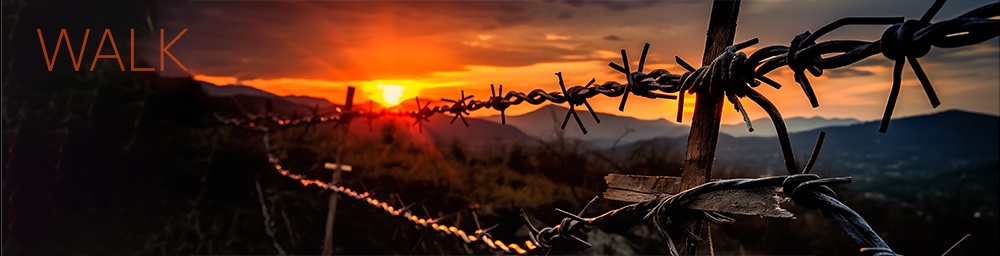
The man wound the barbed wire into loops like garlands, careful not to let it bite. Even now with his sapshell gloves and the wire rust-dulled and its barbs curled inward with time, the metal vine still longed to rip hands as once had. The morning stretched open before him—gold on green, a weightless breeze, and nothing but the long road ahead. He’d been walking it for 29 years. Three decades of clearing the old wounds. And still, the wire came.
The nasty old wire had been stranded over hundreds of thousands of miles over the course of the last few hundred years. And always laid out of fear and greed. Now it was being gathered by hearts filled with hope and trust. Men and women who savored the small joys in life and eschewed the concept of accumulation and acquisition. Their goal now was experience and collecting stories and smiles, giving love wherever they went.
Since the old world ended, life had become more joyous, more pleasant. For a certainly, the man never worried about the mundane any longer. Food and safety had been in abundance since the crumbling of those old governments and the sweeping changes across the face of Aelora (what the new-worlders had renamed the planet). In short, the man's existence had become something to look forward to. Each day got better than the last.
Most words and terms related to a person or things age had become misnomers. Fifty-seven years into this transformation, people had lost track of the years already. They were mostly focused on the simple joy of living. 'Old man' and 'Old Woman' became short hand for those who had lived in and known the former ways of living just before the 'sweep', what everyone called the destruction of that old way of life and it's systems and governments.
Even though millions had tried to imagine what people would face at the end of the world, what it was really like still shocked everyone. There were surprising hardships and fears, but the faithful few anticipated the worst of it and by the grace of their God, they endured.
Considered an old man, one of some few million to see the spires tumble and the cities burn would regale the 'newlings', those post-apocalypse additions, around the dinner table in the evenings from time to time, but his party had been together long enough that they had heard a lot of the old tales. Besides, they were busy making new stories with their lives.
Soon after the end of all things, humans united under the direction of the Creator with a single purpose in mind: to restore their damaged home. Since the population had reduced so drastically in the sweep, a global congress was held with the reaming 6 million people and plans were put in place to start the global transformation into one united park-like home.
The division of labor was massive. Six million is hardly enough to call a civilization much less reshape the globe, and with a planet the size of Aelora, it's less than a drop in the bucket. New births took time and those first children born were now well into adulthood and having children of their own.
The real force of humanity came from those recovered from death, termed 'bloomed'. Those awaked from death quickly adjusted in the early days and the rate of bloomings was growing every month. It seemed slow at first, but in 54 years, humanity was close to reaching the one hundred million mark. Still a tiny fraction of what would be needed to change the face of the planet.
The transformation was scheduled to follow a five-hundred year rough sketch for fundamentals and build on those accomplishments to truly make the world a masterpiece over an additional three to five mellenia. New understanding of weather patterns, moisture and the importance of biodiversity were all the foundation for what humans would set out to achieve. Gone were the ideas of monocultures and sameness. Instead, man would embrace the strengths in difference and enhance what had already been designed and put into place.
The approach would be more akin to the art of bonsai than to construction. Humans no longer wished to force their interpretation of nature, but to embrace what was provided. The elimination of fiat systems and greed along with an abundance of freely available resources meant every hand wanted to pitch in for the work. No one was required to grind away at a single task indefinitely. In the old parlance, the effort would have been considered a 'generational' effort. The kind of thinking that said 'I will plant a tree whose shade my grandchildren will enjoy'. Only now, the planter, the grandchildren and their grandchildren could enjoy its fruits.
Such was the benefit of ideal health and the elimination of death.
Early in, the old man had worked a decade planting and coaxing the western deserts back to life. Hard efforts, but enjoyable. In fact, the most engaging work was not in those places man used to consider stunning or breathtaking, it was in the lands avoided and overlooked. The more abused and neglected, the better the assignment. The fastest changes occurred in the worst places.
But he grew restless after a time, wishing to see more of the new world. So much had changed, not just the people, but the sweep came with massive geologic upheavals resulting in new continental borders and even new continents and many inland seas and lakes.
It had all been mapped, but that just made it more intriguing. Especially for those old-timers who knew the world before. For the benefit of those who remembered how things were, there were special maps that overlaid the old geography with the new, helping them to stay grounded in something they knew while coming to know something they did not.
Which is what brought him here, to this wide grassy prairie, spooling up the miles and miles of rusted, brittle barbed wire. It was a volunteer project that required constant travel. So it meant putting a hold on sinking roots and settling down. But the old man had had plenty of rootedness pre-sweep and not just a little of it post. Wire-gathering tended to attract the curious and those with a heart for adventure. He hungered to wander around and see what was out here with his own perfect eyes.
He had just finished coiling a length of wire—a particularly nasty stretch used by soldiers and designed to harm and to last—when he heard the soft crunch of steps behind him.
“You’re the Wirewalker?” asked a voice—young, lilting, curious.
He turned to find a girl no older than twenty by appearance, though age had little meaning anymore. Her skin was wind-gold, her eyes the bright grey of storm-washed stones. She carried nothing but a small satchel and a flute tied with twine.
“I walk the wire, yes,” he said, smiling gently. “Though some call me Calder. Or 'Hey you, watch your step.’”
She smiled, a little shy. “I’ve heard stories. That you’ve walked across three continents and never once repeated a sunset.”
“Well, they're smaller now, the continents, but that sounds like someone else. I’ve seen a few sunsets twice.”
She smiled warmly at his modest honesty and asked, “I'm new in the world and want to strike out and help where I can. May I join your people?”
Calder studied her face. She was brimming with eagerness—but under that was a hunger. The same sort that brought him to this path when she was still a young child. Not to do so much as a longing to know. To trace the old scars of the world with your hands and feet and feel them give way under time and kindness.
“We would be happy to have you.” he said. “But you’ll need gloves. And a name. The gloves we can probably help with, but the name you'll have to handle yourself.”
She hesitated. “They call me Lira. I haven’t chosen my true name yet.”
It was hard to tell by looks who was a newling and who was old. People no longer aged like they used to. But a short conversation told you quickly. Concepts like choosing a 'true' name came with the new social structure. 20 or 30 years in, a person started to understand themselves enough to take a name in addition to they one their parents had given them.
“Well, Lira-For-Now,” he grinned back, “the road is long, but the company’s good. Grab the other end.”
Together, they lifted another coil from the tall grass. Mice scurried away as they raised the awkward bundle. The morning sang around them—crickets like soft clocks, the wind humming along the wire, the smell of wild basil and warm dirt. Calder felt, not for the first time, that joy wasn’t in finishing a task, but in handing it forward.
That night, the field glowed with a dozen small lights dangling from wagons, dim and inviting. Campfires like fallen stars, each one circled by laughter, hot meals and by the shimmer of voices rising in song.
Calder sat cross-legged near one of the fires, a bowl of plum stew in his lap, bread still steaming on a leaf beside him. Lira sat nearby, humming quietly as she polished her flute. She had earned her place without ceremony—she laughed and labored as hardily as any of them, her back sweat-lined and sun-kissed.
Around them, the night danced with fireflies.
A boy with bright eyes and a shock of blond juggled glowing stones. A woman spun through the grass with her arms full of ribbons, laughter trailing behind her like a kite tail. Others clapped and sang an old working song, one Calder remembered from his early days coaxing green from dust that praised the Maker for the privilege of the work.
The fire cast long shadows across the circle, and as the song ended, a hush took its place. Not silence—there was always the murmur of wind and ember—but a kind of group sigh of joy.
Someone across the flames looked to Calder.
“Tell us a story, Wirewalker.”
A low chorus of agreement followed.
He didn’t rush. He sipped from a cup, let the fire’s warmth stretch across his face. Then he leaned forward.
“All right. But not one of the old-world stories. You’ve heard those. Tonight I’ll tell you about the owl and the fence.”
Lira and the others leaned in, eyes bright.
He smiled at the memory. “It was year four of the wirewalk. I was working mostly alone in those days. I was in the hill country—what used to be west Texas, before the reshaping. There was a stretch of fence so tangled it looked like a nest made by a mad god…”
And as he spoke, the fire crackled and popped, while the group sat inhaling the night and the story.
“Wire ran through the valleys and over hills like veins, buried in earth and wood. Some of it was so old the tree lines had grown through it, swallowed it whole, but it still cut. That’s the thing about old pain—it lingers even after it’s forgotten.
I worked and tugged and gut for hours before I got that tangled stretch loose. Then I saw her. An owl—huge and white, with rust-colored rings around her eyes, like she'd seen centuries. She sat on a old crooked fence post.
She didn’t fly away when I got close. Just stared, unblinking. I watched the owl, it watched me. I was looking for what she would tell me about the Creator. I'm not sure what she was seeing in me.
That night, I camped near there. I dreamed of her. In the dream, she spoke—not with words, but with presence. I felt… watched over. Not judged. Just seen.
The next morning, I went to take down that final stretch of fence—the one where she’d perched. It was the old stuff they called concertina, coiled and razor sharp even after decades of rot. I fought it, it fought back. I bled a little, not much but enough to give me pause.
And I heard the owl again. Not in dream, but in the trees above me, real wings, real eyes. She landed near my satchel, then hopped over to the coil of wire I’d cut. She grabbed a strand with her beak and yanked it free flying away.
I watched as she glided over to the edge of a ravine. Landing on the edge, she looked at me, turned her head and dropped the wire into the crevasse, looked back at me, took wing and disappeared.
I walked to where the owl had been perched and peered down. That bird had been tellinrg me there was a den of foxes. Kits no bigger than my hands. That stretch of fence had been their shield from the wind and the coyotes. If I had taken it all, they would’ve died exposed.
So I left a piece behind.
That was the first time I realized—not all fences were meant to come down. Many were wounds, yes. But some had been repurposed by time into shelter, into homes for fur and feather. Even wire can turn to grace if you give it long enough.”
Calder sat back, letting the words settle.
The fire popped, and the wind moved like a slow breath through the tall grass.
Someone whispered, “What happened to the owl?”
Calder looked into the flames.
“I never saw her again. I did find a feather in my tent the next morning. I've carried it with me since. It's not magic. But when things get tangled, when I don’t know what to pull or what to leave, I touch it.
Reminds me to look at the bigger picture. To be objective about our goal.”
This answered the question why Calder would walk off in the distance and watch the team. He was listening to the wind and looking for scars that had become not a danger, but a home.
People always came. Sometimes they were residents of an area, others they were adventurous souls looking to make new stories. People left. For family, for new interests, for all kinds of reasons. Sometimes they left to go wire walk on their own in new places they'd heard needed the effort.
But they started coming in greater numbers from all directions. Not in a rush, not like pilgrims chasing salvation—but like seeds on the wind, guided by stories.
The tale of Calder and his thirty-year walk had spread quietly through the people of Aelora. It wasn’t shouted or broadcast; there were no posters or announcements. Just stories passed from voice to voice, in gardens and starlit kitchens, in the quiet hush of learning halls, and around other campfires where feet were tired and hands were raw from the day's honest labor.
Calder started to feel his time here as wire walker was perhaps starting to come to a close. This w as challenging feeling for him. He did not want to abandon the work. And there was so much work left to do.
Hardly a person was left from the team he'd known even five years ago. All new faces and new thoughts. There was a particularly efficient group of four that Calder felt, maybe, just maybe they cold carry on the work without him. The New Circle—that’s what they called themselves. They weren’t appointed. They chose each other by instinct.
At the center was a young woman named Mira, barely sixty, but already steeped in the arts of land-listening—a discipline that required stillness and intuition more than talk. Where Calder cleared the wire, Mira listened for where it had once grown roots. She could walk a field and feel the ghosts of boundaries long since buried.
She had heard Calder speak once, years ago, and never forgot it. Not the words so much as the weight behind them. He made the past feel like a garden gone wild, not something to burn down, but to prune and nurture.
Mira wasn’t alone.
There was Thom, with arms like tree trunks and a voice like a cracked bell. He sang as he worked, old ballads and newer ones made from scraps of Calder’s tales. He had a knack for lifting the heaviest pieces of scrap with a gentleness that felt like prayer.
Lale, the twin-hearted recorder and historian, traveled with them too. She marked the lands they passed, not just for what was removed but for what was revealed—old stones carved with names, bits of bent metal grown mossy with time, relics that told of boundary and belonging.
And there was Juno, the silent one. No one knew quite why he’d joined. He never said much, but he moved with a purpose that made space for others. He was the first to spot owl feathers on the trail. The first to pause before pulling wire that seemed... unready.
Together, they didn’t mimic Calder—they echoed him, in new keys.
Their mission wasn’t to follow in his footsteps, but to branch out where he hadn’t yet walked. They moved toward the wetlands, where rust had sunken deep into soft soil, and the wire whispered with half-buried history.
One day, as they circled a fire much like Calder’s, Mira held out a map—not printed, but painted on silk, small flowers painted places they thought they might do the most good.
It was covered in circles. Concentric ones. Intersecting ones.
“We’re not the only ones anymore,” she said quietly.
“There are others. Everywhere. Little clusters of listeners and lifters, untanglers and wanderers. Calder lit the path. But we—we’re building the constellation.”
By the time Calder met the New Circle, he had stopped measuring time in years. He marked his days instead by how the land changed—places with mighty trees that had once been barren, where wildflowers returned, where birds nested without fear, where the earth no longer remembered pain.
He met Mira on the edge of an estuary, her boots half-buried in brackish sand, eyes scanning the horizon not for danger, but for meaning. They spoke little at first. Just smiles, nods, hands offered to help with a heavy spool.
Later that night, the fires flickered in harmony—his group and hers, the old and the new, eating together under a moon so full and silver it made the night electric. Someone played a reed flute. Someone else carved a circle in the dirt with a stick, absentmindedly. A symbol, unspoken.
Calder looked around. Dozens now, maybe hundreds, had taken up the work. The wire was being unwound from the bones of the world—not just removed, but honored—its rust no longer poison, but memory. They melted it down, turned it into sculpture, plows, and garden gates.
The past had not been forgotten. It had been reclaimed.
Mira asked him what he would do next.
He smiled.
“There’s always more to clear. But I think it’s time I started planting again.”
And so he did. With younger hands beside his, and laughter in the wind. He carried no tools now but a spade and a flute, and sometimes he would stop at the edge of a newly unburdened hill, plant a tree, and hum a tune no one remembered teaching him.
Across Aelora, the last remnants of division turned to myth. The only remaining parts were fragments in museums that in time would turn to dust themselves. The scars of the old world faded like the creases in Calder’s once-calloused palms.
Peace was no longer a hope, but a habit.
The world did not end.
It unfolded.
#shortstory #reading #story #newworld #100DaysToOffload #Writing

WolfCast Home Page – Listen, follow, subscribe
Thank you for coming here and walking through the garden of my mind. No day is as brilliant in its moment as it is gilded in memory. Embrace your experience and relish gorgeous recollection.
Into every life a little light will shine. Thank you for being my luminance in whatever capacity you may. Shine on, you brilliant souls!
— Go back home and read MORE by Wolf Inwool
— Visit the archive
I welcome feedback at my inbox