Patterning this paper. And a conceptual weave
A politics of language(ing)-of-struggle
 Patterning. Left: A yew, 1,100 years old, in the churchyard of the Norman settlement of Sullington, under the South Downs in Sussex. The manifest patterning results from fluids being pumped, woody material being deposited, space filling and light seeking by growing wood-fabric and leaves, seasonal-generational expansion, seasonal weathering. The patterning appears like a storm, slowed, materialised and enduring: in a calm green secluded churchyard. Right: The railway station of a small town in the Pennines, West Yorkshire. The railway is here because the settlement was here, because the pass over the Pennines was here, because the river was here. The town is the town that it is today, arty and busy and self-consciously a haven, because the railway was here, running from city to city, Leeds to Manchester, bringing regular access from all parts of the railway network. The town also is a slowed storm – even if this picture fails to show it. Very few of these patterns were intended. Intentional patterning is order of some other kind, some other composite of kinds of work and contingency.
This is part 4 of Melancholy territory, activism in deep time and life in the collective – Dancing a living economy. One intention in the Methuselah papers is to (eventually) generate and continuously evolve a pattern language of making a living economy that powerfully supports activism beyond the fragments, and beyond the hegemonic present, into deep time. Thus we can close this introductory subset of papers by nominating some patterns (as patterns in triage) which seem to be implied by what we’ve identified in this introductory stream, and mean to explore in four papers to follow.
First we describe the ‘container’ that we put the patterns in: the foprop weave. It’s constructed with the zones and landscapes from an earlier paper:The scope and reach, in-here and out-there.
A weave
That paper identified four ¿zones of reach and three §landscapes.
Shorthand: ¿ is pronounced ‘zone, § is pronounced ‘landscape’
We use the zones and landscapes as columns and rows, to generate a 4x3 conceptual space or container into which we might map pattern families, on a work-in-progress (triage, experimentation) basis: as below. We call the space ‘the foprop weave’: foprop = forces of production, relations of production and we have a project of ‘college(ing)’ organised around the weave: Making a living economy – The foprop project.
The §landscapes are the distinct kinds of stuff we need practically, mundanely, to engage with-and-in, as inhabitants of a material, social world. The ¿zones of reach are the different orders of proximity (intimacy, availability) and reach (or ‘rippling’) and transience that we may aspire to – and equally, may be limited to – as activist-organisers. The foprop frame thus looks like this below, showing 40-or-so pattern families (in triage, under evolution).
It’s a space for mapping our ontology and our plural relationships with ‘the stuff’ of our lives, and thus, for re-ontologising the world we inhabit – making a path by walking – as people and collectives committed to root-and-branch transformation, wellbeing and an end of suffering for all beings, in all generations. Aka activists.
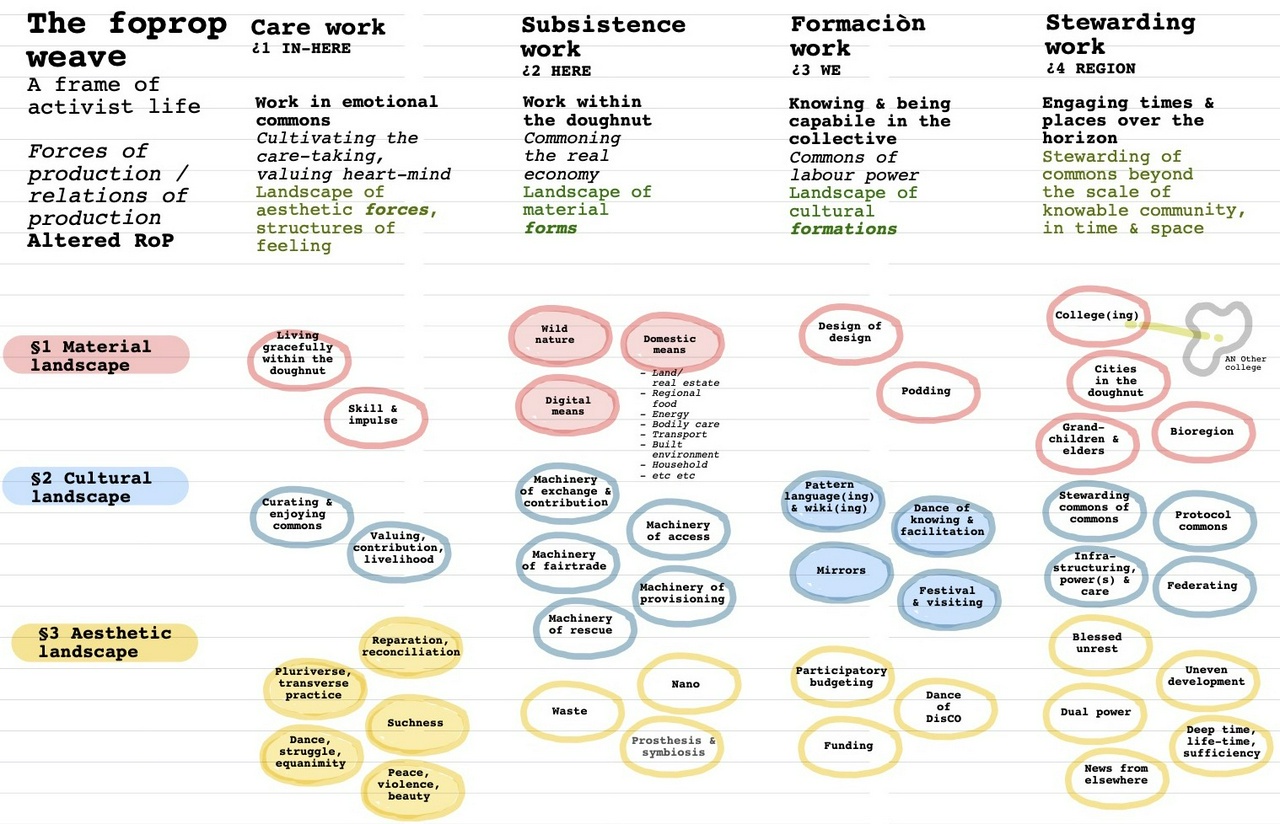 Within that frame of landscapes, zones and families, the following pattern possibilities can be located, which have arisen in this present stream of exploration: Melancholy territory, activism in deep time and life in the collective. The patterns are also held in federated wiki: pattens in triage.
In this blog we haven’t yet presented a description of pattern language or pattern language(ing), or the reasons why we believe that these are practices to be adopted as means of collective memory and creative organising. However, there are notes here in federated wiki: Pattern language(ing). For the present, it’s enough to recognise that pattern names below are themes highlighted in earlier posts in this thread of Methuselah papers, and also that ‘the weave’ is just a conceptual container – a structured space, a map, if you like – in which many different kinds of patterns can be held for reference, in relation to one another, under the broad framing of four #zones of reach.
Patterns in families, in triage
Below, pattern family appears in italics next to the name of a pattern-in-triage.
Work in emotional commons – Transforming structures of feeling zone¿1
- In oceans of emotion, making landfall – Dance, struggle equanimity
- Dancing gracefully in deepTime – Dance, struggle equanimity
- Deliberately inhabiting the personal-political – Pluriverse, transverse practice
- Beyond fragments – Mutualising seven ‘Rs’ of activist commitment – Pluriverse, transverse practice
- Not autonomy; beauty – Suchness
- Being at home in and around melancholy territory – Skill & impulse
Work within the doughnut – Commoning the real economy zone¿2
- Everything in the commons – Dancing the living economy – Commoning the real economy
Work of knowing & capability in the collective – Commons of labour power zone¿3
- Positioning our selves in the collective – The capability of ‘we’ – Skill, genre, concept, story
- Pattern language(ing) – Pattern language(ing) and wiki(ing)
The work of stewarding commons – Beyond the scale of knowable community zone¿4
- A grown-up life in the embrace of the earth – Deep time, lifetime, sufficiency
- Voices for all the actors – Uneven development
- Respecting pocket regions of elder diversity – Uneven development
- Low intensity struggle supporting high intensity struggle – Uneven development
- Infrastructuring in all the §landscapes – Infrastructuring & federating
- Recognising and committing across all ¿zones of reach – College(ing)
- Never forgetting power(s) – Dual power
Fine and coarse grain – The ‘smallest’ and ‘largest’ zones
Looking at the spread of these patterns across the zones of reach, we can see that the weight of this present subset of papers sits in ¿zone 1 In-here and zone ¿4 Region. Although ¿1 may seem ‘the smallest’ or most intimate zone of reach, and ¿4 may seem ‘the largest’ and most intractable, this highlights the ways in which they actually sit very close.
On one hand, the fine grain of in-here is just as intractable as the deep time and poly-regionality of ¿4 – because zone ¿1 is fundamentally the zone of the preconscious: the fundamental field of ‘power’, capability and relationship in human existence, within which everything is ‘unknown’ – until it pops up, in action, in prejudice, in desire, in commitment, in habit, in love and hate, greed and aversion, in manifest delusion. That ‘popping up’, at the moment where an intention is formed out of sankhara and saññā and tathātā, is where the rubber hits the road; living here, in this moment, is a domain of profound and rather rare skill.
This is where the rubber hits the road. Living here, in this moment, and responding with grace, is a domain of profound and rather rare skill. But – we must believe – it can be attained. Otherwise, what is a human being?
On the other hand, the unknowable, radiating, rippling futurity of ¿4 must needs be made tangible, in the skilful ways in which we become able to recognise and to moderate our desire and our intention here and now; being unswayed in the Eight Worldly Winds, stepping aside from hubris, being realistic about the sorrow and the joy of grandchildren’s grandchildren, falling with wisdom and awareness into the arms of the ultimately powerful Earth. This enormously ‘out-there’ challenge is met in a deeply ‘interior’, fine-grain practice of the highest order.
Melancholy territory – Special pleading? A retreat from politics?
A final note in this introductory swathe of the thread Melancholy territory, activism in deep time and life in the collective. In framing this paper from the standpoint of melancholy territory I’m being forcefully assertive, but it’s not special pleading from a position of oddness or marginality. There is someone very close to you who inhabits melancholy territory: your child, your father, your comrade brother or sister, the person you fold your arms around when you come home to bed; yourself, maybe.
Melancholy is not on the fringes even if it is frequently on the fringe of respect or recognition; or beyond, cast into in the wastes – as, for example, with ‘eco-miserabilism’, ‘deep adaptation’ or the Black Mountain perspective, in the field of responses to climate catastrophe.
Melancholy territory is common ground: frequently frequented (commonly occurring), frequently present (widely held in common), in human existence. Also, a space in which contributions in the collective must be anticipated and facilitated, in the weave with all the others: all the voices.
This will help us to see and inhabit the plurality and totality more clearly.
Seeing this more clearly will help us to see the plurality and totality more clearly, and to have wiser intentions, deeper skills and a more fully capable mix across all the visions, capabilities, needs and contributions that recur and arise and seethe in global civil society and in the cultural-aesthetic memory of humankind. Contrary to widespread perceptions of eco-miserabilism (for example), there is not an abandonment of politics, but a great deepening of politics, into the radical, root-and-branch altering, in everyday living and working, of relations of (re-) production in all the landscapes: §1 #material, §2 #cultural, §3 #aesthetic and across all the zones of reach: ¿1 #in-here, ¿2 #here, ¿3 #we, ¿4 #region.
There is pleading here (our times are outstandingly hard) but it is entirely general, not special.
The Methuselah papers
Elder regions, deep time, living economy
https://write.as/papers/
This is mike hales, blogging on pattern language(ing) and language(ing) of struggle, as everyday activist practices in making a living economy. Aka the insurgent power of commoning, and the struggle for the commons of everything and for the grandchildrens' grandchildren.
To subscribe
Contact and comment:
– Email: blog AT conviv.mayfirst.org
– Fediverse (Mastodon) : @mike_hales@social.coop
This blog is linked with some sister sites:
– The foprop frame – Pattern language of making a living economy
– A book of skill – The living and storying of an activist life
– Methuselah papers – Mirror site for the blog, in the fediverse
Book downloads are here including Living thinkwork (1980) and Location - Explorations of power(s) and landscapes of design (2016).