Hot off the Press: ULUS: What If? / Šta bi bilo kad bi bilo?
By Milan Đorđević, Noa Treister, Tijana Cvetković
srpski ispod
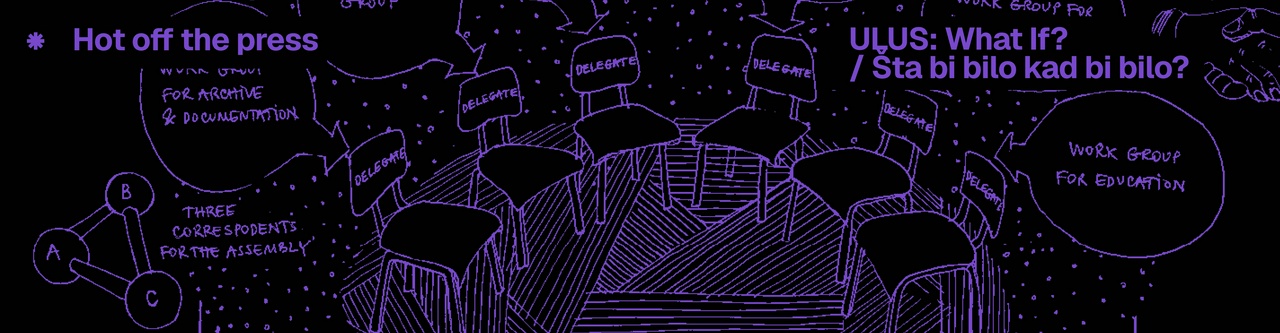
One of the questions that arises in the course of building our cooperative is how we imagine its structure, and on which experiences we want to ground its principles. If the founding of the cooperative is an attempt to overcome the problems of a fragmented art field and to create collective mechanisms for managing resources, then it is useful to look at examples available to us in the local context, where most artistic work takes place. The text we share here deals with the Association of Fine Artists of Serbia (ULUS), the largest professional association of visual artists in Serbia, with nearly three thousand members.
It is organised according to a model typical of professional associations from the early twentieth century, with sections based on artistic disciplines, a centralised administration, and a hierarchical logic of decision-making. However, the experience of the last decade shows the efforts of part of its membership to transform the association into a more inclusive and participatory framework, while facing problems that are far from uniquely local: how to align collective interests within the conditions of a capitalist state, how to develop mechanisms of solidarity, how to create sustainable models of financing, and how to establish space for genuine member participation in decision-making.
ULUS holds significant symbolic capital and substantial infrastructure, but its operations remain constrained by legislative frameworks, lack of state support, and the presence of quiet hierarchies within the association, accompanied by clientelist relations and the reproduction of inequalities among artists.
Sharing this experience is very relevant for us at the time when we ourselves are working on the cooperative bylaws for the first international cooperative of visual artists based in Serbia.
You can download the text here.
—
Jedna od tema koja se nameće u okviru našeg poduhvata izgradnje zadruge jeste kako uopšte zamišljamo njenu strukturu i na kojim iskustvima gradimo njene principe. Ako je osnivanje zadruge pokušaj da se prevaziđu problemi fragmentisanog umetničkog polja i da se stvore kolektivni mehanizmi za upravljanje resursima, onda je korisno pogledati primere koji su nam dostupni i u lokalnom kontekstu, u kojem umetnici najviše rade. Tekst koji delimo ovde bavi se Udruženjem likovnih umetnika Srbije (ULUS), najvećim strukovnim udruženjem vizuelnih umetnika u Srbiji, sa skoro tri hiljade članova.
ULUS je organizovan po modelu tipičnom za profesionalna udruženja iz ranog dvadesetog veka, sa sekcijama prema umetničkim disciplinama, centralizovanom upravom i hijerarhijskom logikom odlučivanja. Međutim, iskustvo poslednje decenije pokazuje napore dela članstva da transformišu udruženje u inkluzivniji i participativniji okvir, suočavajući se pritom sa problemima koji su daleko od specifično lokalnih: kako uskladiti kolektivne interese u uslovima kapitalističke države, kako razviti mehanizme solidarnosti, kako izgraditi održive modele finansiranja i kako stvoriti prostor za stvarno učešće članova u donošenju odluka.
Reč je o organizaciji koja raspolaže snažnim simboličkim kapitalom i bogatom infrastrukturom, ali čije delovanje ostaje ograničeno zakonodavnim okvirima, nedostatkom javne podrške, te tihim hijerarhijama unutar udruženja, praćeno klijentelističkim odnosima i reprodukcijom nejednakosti među umetnicima.
Upravo zato delimo ovo iskustvo u trenutku kada i sami radimo na zadružnim pravilima prve međunarodne zadruge vizuelnih umetnika sa sedištem u Srbiji.
Publikaciju možete preuzeti ovde.