Report on Radionica #5: (This is Not an) Open Call, Novi Sad, September 19-22, 2025
By Dunja Stanojević
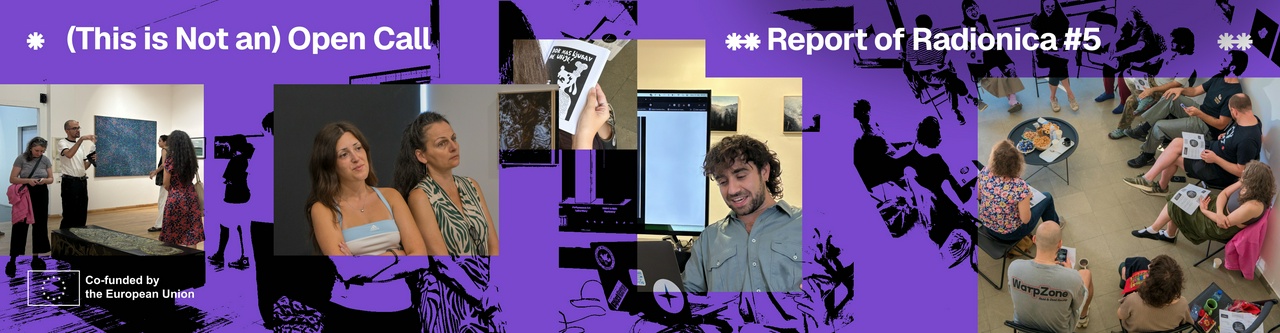
Each workshop within the Shared Visions project has built on the previous one, gradually expanding discussions about how artists and collectives can share resources, make decisions together, and sustain collaboration over time. Radionica #1 introduced sustainability practices and resource-sharing at individual and organisational levels, while Radionica #2 focused on networks, collaborations, and hands-on exchange. Radionica #3 (LuckyLandCoop/Mutuogenesis) focused on practical experiments with collective decision-making, governance tools, and co-ownership models. Following this path, Radionica #4 explored barter and exchange practices as alternative ways of organising collaborative work.
Earlier workshops explored questions of fairness, collaboration, and community-driven practices, but mostly in discussion. Radionica #5 offered a chance to put these ideas into practice, using interactive tools to experiment with new ways of making decisions or sharing resources. In that sense, it was both a continuation and a step forward: building on what had already been learned while creating new opportunities for practical use and contemplation.
The participating practices included the five selected initiatives from an open call: Club Podzemljica, KC Radionica, Oaze 2.0 /Artist in the Local Community, Urban Sketchers Novi Sad, and Vishni Residency. The call invited collectives and artists from the Balkan region to take part in a workshop that explored how open calls themselves might be rethought. Unlike typical open calls, which demand polished proposals and often leave most people with nothing, this one was different: it invited artists and collectives to bring ideas in their early stages that could later grow within the cooperative itself. The goal was to explore how sharing, learning, and working together could shape creative projects, replacing the typical competitive format with one rooted in collaboration and mutual growth.
The workshop opened with short presentations from the participating practices, each showing how they work within their own contexts. For instance, the Urban Sketchers Novi Sad spoke about their gatherings in the city’s streets and parks, sketching everyday life as a way to observe and celebrate the urban landscape. Another initiative, Oaze 2.0, reflected on how something as simple as a shared bench can become a meeting point, sparking dialogue and collaboration in both cities and villages. From a different angle, situated in Kragujevac, Club Podzemljica brought in the DIY energy of zine-making, screen printing, and poetry; showing how small, collective publishing can keep culture accessible and participatory. KC Radionica, a Belgrade-based cultural space founded by an artist whose practice centres on performance, presented its multifaceted program that includes exhibitions, concerts, and community gatherings, in a space that acts as a home for experimental work and collective activities. And from across the border, the Vishni Residency described their work in a small North Macedonian village, where artists live and create side by side with locals, blending artistic practice with everyday life. Each practice revealed a different path toward collective making: the Urban Sketchers’ open and inclusive gatherings, the poetic simplicity of community furniture, Podzemljica’s blend of art and publishing as activism, the vulnerability and presence explored through performance, and Vishni’s model of living-artistic coexistence. Together, they painted a picture of art as something deeply social. Something that grows through collaboration rather than competition.
These projects served as a reminder that art doesn’t always have to culminate in an exhibition, or any other traditionally anticipated outcome – it can exist in a workshop, a printed zine, a public bench, or a collective meal. Meeting these practices was a refreshing perspective on different ways of working. Many operate in open, collaborative, and community-centred ways, experimenting with processes that extend beyond traditional exhibitions or projects. With trust in institutions eroding and public support for independent culture shrinking, artist-led collectives have become some of the few spaces where genuine collaboration still happens. They fill the gaps left by unstable systems by creating their own frameworks for care, visibility, and collaboration where none previously existed. They prove that creative work can still thrive, even if formal systems fail to provide it. After the events of the past year – the Novi Sad train station canopy collapse and the student protests and strikes that followed, there is an obvious shift in the local scene. A shift that, in many ways, has reshaped trust and relationships within the local community – leaving people more open to exploring cooperative, community-driven, and sustainable approaches to making and sharing work.
And then, of course, someone had to mention blockchain. 💔 However, the introductory blockchain session with Alessandro Y. Longo didn’t come out of nowhere – it picked up on threads that have been woven through Shared Visions from the very beginning. Concepts like Circles UBI, Crypto Commons, and other decentralised tools have already shaped how we imagine shared structures and alternative economies. Circles UBI, for instance, was a cooperative basic income pilot in Berlin using blockchain technology, which treated currency as a network of mutual trust rather than a pure transaction, tying social relationships to technological protocols. Alessandro, as one of the pilot’s drivers, brought that perspective into the session. His presentation, framed as a “radical tech lexicon”, offered an introduction to the jargon and mindset behind these terms – DAOs, commons, cooperative infrastructures, community currencies, etc. (Alessandro also built on the lessons from our reading group, which he wrote about here, on our blog.) It helped unpack how such tools are being used to rethink ownership, governance, and distribution in self-organised creative spaces: where trust can be encoded, resources shared more transparently, and collective action supported without relying on centralised institutions.
The notion of a “majority” often passes unquestioned, as if to insinuate that fairness was exact and measurable. The familiar and most common principle of “one person – one vote” carries its own limitations; it’s a structure that simplifies complex intent into countable choices. It begs the questions – What does it mean to agree, to differ, or to withhold in collective settings? And how did this particular logic come to stand as the default expression of democracy? Maybe experimenting with different forms of decision-making is less about efficiency and more about sensitivity – learning to adapt to the coherence of a group, where consensus might emerge in ways that numbers can’t quite capture.
This line of thinking set the stage for an experiment involving quadratic voting (QV) – a voting system which allows people to express not only what they prefer, but how strongly they feel about it, offering a more nuanced alternative to a simple yes-or-no majority. Here’s how it worked: Each participant received a limited number of voting credits (99 in this case), which they could distribute across the five projects. The “cost” of each additional vote increased quadratically (one vote cost one credit, two votes cost four, and so on), encouraging participants to think strategically about their strongest preferences. The voting took place anonymously through the RadicalxChange platform, with everyone (both the organising team of the Radionica and participants) voting on how to allocate the open call funds.
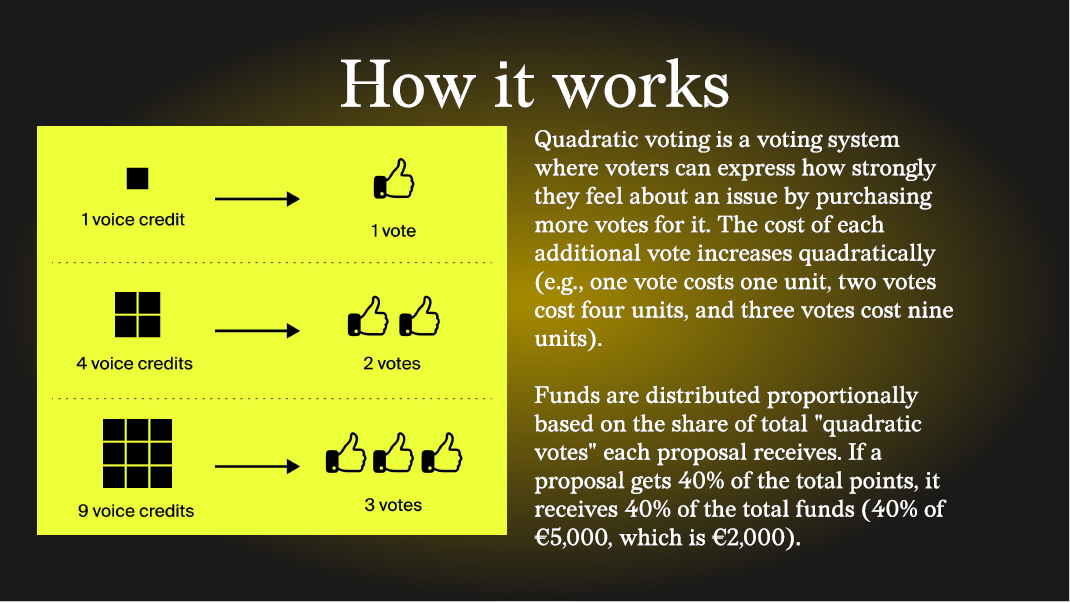 Segment from the presentation on QV
The overall budget of €2,500 acted as an example of how collective allocation could function in reality. Although the outcomes revealed varying degrees of support (with Podzemljica gaining the highest number of votes), the group ultimately agreed to distribute the total equally. This was not a contradiction but a deliberate choice – the voting was never intended to foster competition, but to engage in and contemplate collaborative decision-making itself. In that regard, the voting was not focused on efficiency or results; it was centered on gaining knowledge and the practical implementation of shared governance.
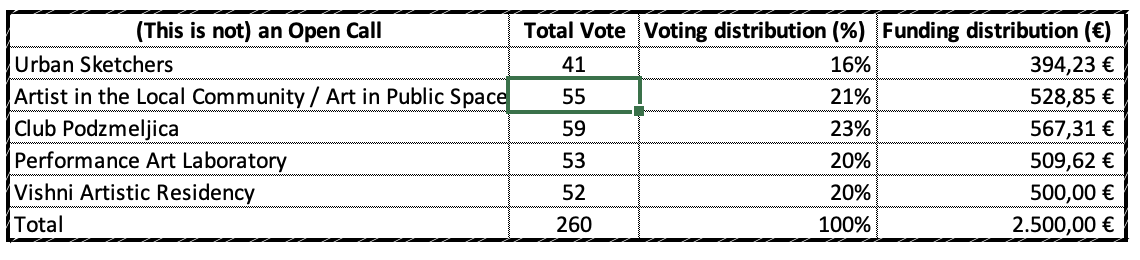 Screenshot showing QV results
Within collective decision-making, the experiment with quadratic voting opened space for reflection on fairness, participation, and redistribution. Participants could also redistribute their votes across different projects, change their preferences, and see the proportional impact of their choices visualised in real time. The visual interface, where each additional vote is represented as a square, made the outcomes feel transparent and easy to interpret. The feedback from the participants indicated that this method could become even more engaging with a larger number of projects, where collective preference would become more apparent. One of the few challenges noted was the occasional difficulty participants felt when they were left with unused voting credits. This happens because each additional vote “costs” exponentially more, making it almost impossible to always spend the exact total amount of available credits. We talked about how, beyond funding decisions, quadratic voting can also be used to explore different dimensions of cooperation, from setting priorities in collective work to reflecting on how fair or transparent distribution of resources could work beyond the workshop (in real-life collaborations, organisations, or co-op structures).
So, instead of the old “jury making decisions behind closed doors” approach, the workshop turned the process into a shared experience. Each person received a limited number of credits to distribute across the projects they cared about most, and tested how personal priorities shape collective outcomes. The idea was to see whether decision-making, usually framed as competition, could become a tool for mutual support and learning instead.
Overall, Radionica #5 wasn’t about tidy conclusions or predetermined outcomes. It was about trying things out together, seeing what works, and how small choices and interactions can ripple through a group. Participants explored ways of working that are less scripted and more responsive, noticing how decisions unfold when everyone has a role in shaping them. It showed that cooperation isn’t an abstract value; it’s something you live, test, and experience. It’s something fluid, constantly shifting with every hand that shapes it; something that remembers and changes with everyone who touches it.