Start Designing for Native Plants
This time:
- Design tips for starting a habitat garden
- How to maintain winter housing for beneficial insects in late summer / early fall
- free detailed fact sheet from the Xerces Society!
I have been helping my mother move out of her house. Her large garden has roses, hydrangeas and peonies. But what has really thrown me is the amount of chemicals that have been stored in several locations. Pesticides and fungicides, in powder and liquid form, concentrates and ready-to-use. Some are very old and the containers are leaking. They will all require special disposal according to the rules in her city because they are poisons.
This is not uncommon with traditional gardeners who have been at it for decades. These chemicals have been an integral part of the process. They have been necessary to meet the goals of the traditional garden, which unfortunately has little connection to helping the environment. Rather the goal is to design to a particular aesthetic.
As beautiful as the outcomes of this style of gardening are, they inevitably create killing fields for birds, butterflies, native bees and other beneficial insects. These traditional gardens are part of the reason why populations of birds and butterflies have been decreasing drastically.
But now it is time to put away these poisons in favor of a gardening style that creates a home for the nature that improves our mental and physical health. It's time to design gardens with more native plants that thrive naturally and do not need additional chemicals to survive.
Design for Mass Plantings. For many of these natives, it works better for design and habitat if they appear in mass plantings. A couple of examples:
- A prairie-like display, where there are many species together that bloom all through the growing season. Habitat gardeners sometimes use special beds or replace a portion of their lawn with such a display.
- A garden bed filled with the same native plant, that attracts populations and serve as a food source for the larva of certain pollinators. For example, varieties of Milkweed or Butterfly Weed (Asclepias) is known as the only food source for Monarch babies.
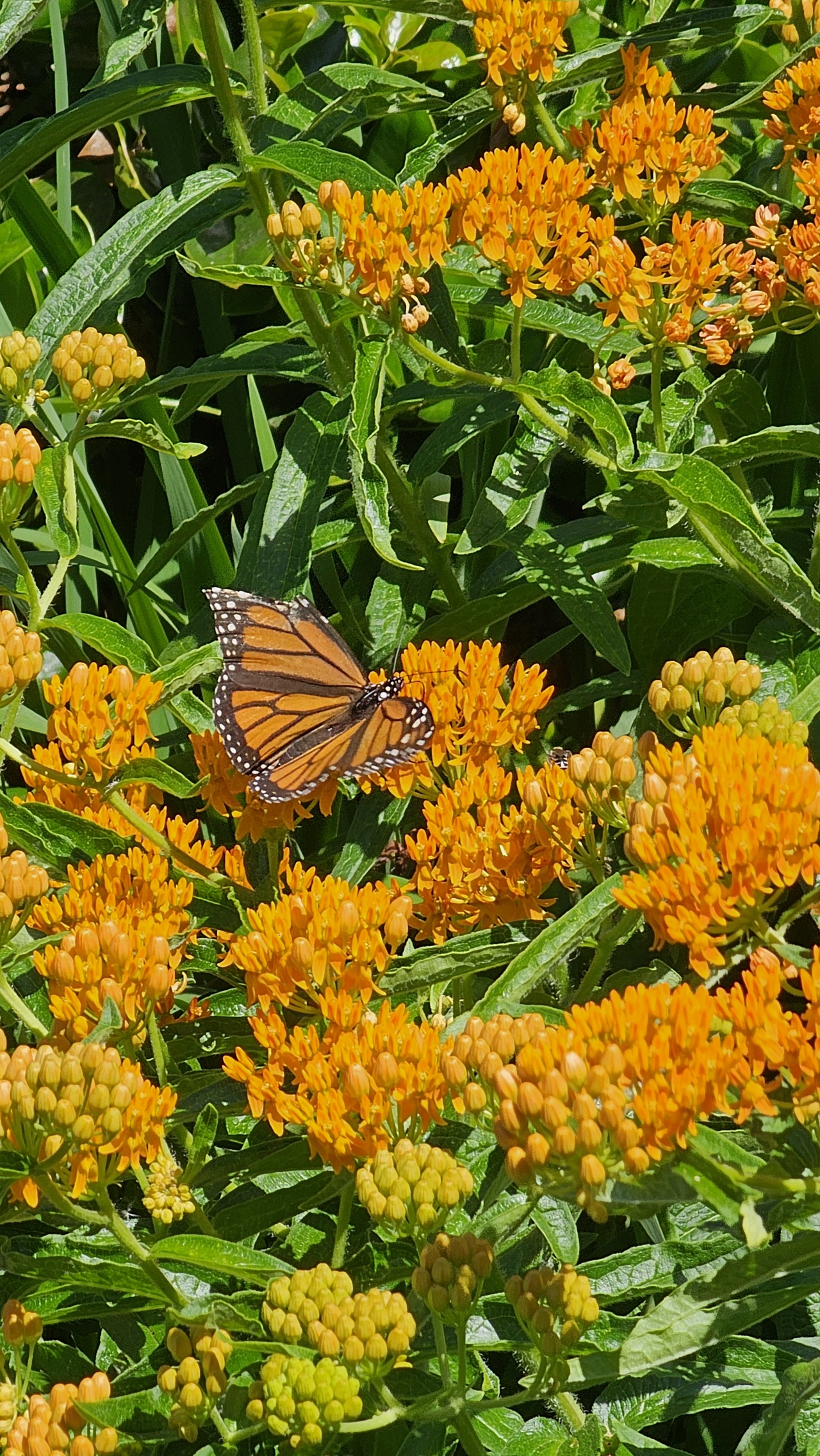 Butterfly weed is allowed to grow freely in one of my garden beds and attracts all kinds of pollinators. Monarchs appear also to be laying eggs and successfully reproducing here. When designing, add space for native plants which are the foundation of habitat for birds, native bees, and butterflies.
Think about how you can make adjustments in your garden design to add native plants to improve habitat for birds, native bees and butterflies.
- Do you have a garden bed that can be converted to contain native plants? It might be a bed where there is a spot where you usually place annuals. Your annuals can then be native plants. Native plants can be grown from seed or purchased as small plants just as non-natives that are usually available.
- Do you have a space in an appropriate area in your yard that can be converted to a mini prairie-like zone? It could be an abandoned garden bed or a corner of the yard that is not used. Consider what basic preparation the area needs to contain native plants. If the garden bed was abandoned because it was too much work to maintain in the hot summer, the good news is that native plants take less maintenance because they are better suited for your area. (I notice this by having to water natives far less than other plants.)
- Native plants include shrubs and small trees, so in your design plans feel free to think about an area that has multiple heights, perhaps small trees and shrubs in the back with shorter flowering plants in the front. Designing with native plants can be very similar to traditional design.
Start with a simple design change to see how you like the benefits, such as more birds singing and more butterflies fluttering around you. When you plant natives as a supportive habitat, you will also be able to avoid using the traditional garden poisons.
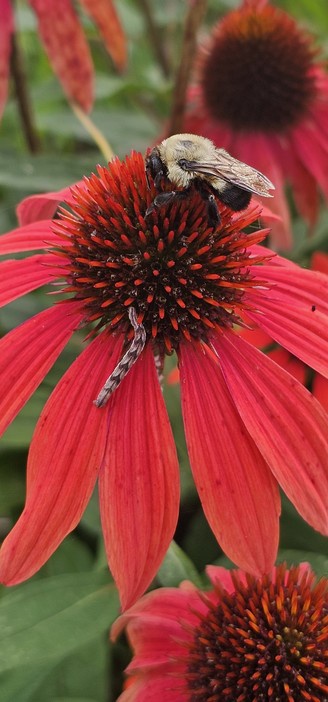
In a garden bed that contains perennials, there was a spot for annuals where I started growing native Coneflowers. These attracted many pollinators, caterpillars and, once seeds emerged, Goldfinches. When designing, select plants that support more species.
Continuous Improvement Seasonal Tips: Late Summer Early Fall
Traditional yard cleaning up is deadly for pollinators, and for bugs that birds feed on! Many invertebrates overwinter inside plant stems. When you discard the stems as part of “Fall cleanup,” you allow populations to die off in the winter. Birds need that material for spring nest building as well.
“The availability of nesting and overwintering habitat is one of the most important factors influencing populations of native bees and other beneficial insects.”
- The Xerces Society
To help populations increase in number with a supportive habitat, you will need to have a plan for dead plant stems. Of course, you do not want your yard to look like an abandoned farm. Your plan will help you find places where the dead plant material can be placed out of site, or in an appropriate spot.
I leave dead plants standing for as long as I can. Many are clipped to a different height for easy access by native bees. The ones hidden from public view in the back yard I leave for a long time. When any need to be moved, I cut low near the base and hide them under shrubs, behind trees and so on. For dead material that I remove in the summer for some reason, I can feel safe to break those up into sections for more winter hideaways.
Recommended Resource
For more on creating winter hideaways for pollinators and potential bird food, you can't do much better than this free fact sheet from the Xerces Society, the group that studies just this kind of thing.
Fact Sheet: Nesting & Overwintering Habitat For Pollinators & Other Beneficial Insects
This covers how to manage your plants each season to maximize beneficial insect populations. Also includes details on providing water, using mulch safely, and creating a brush pile. Other information here will be covered in future posts.
#HabitatGardening #Gardening #BiodiversityGardening #NativePlants #Nature #Environment